Industrial heating rarely operates at one constant load. A textile dyeing process, for example, may need substantial heat during one stage and considerably less during another. The burner therefore needs to respond without losing stable combustion or forcing the system into unnecessary on-off cycling.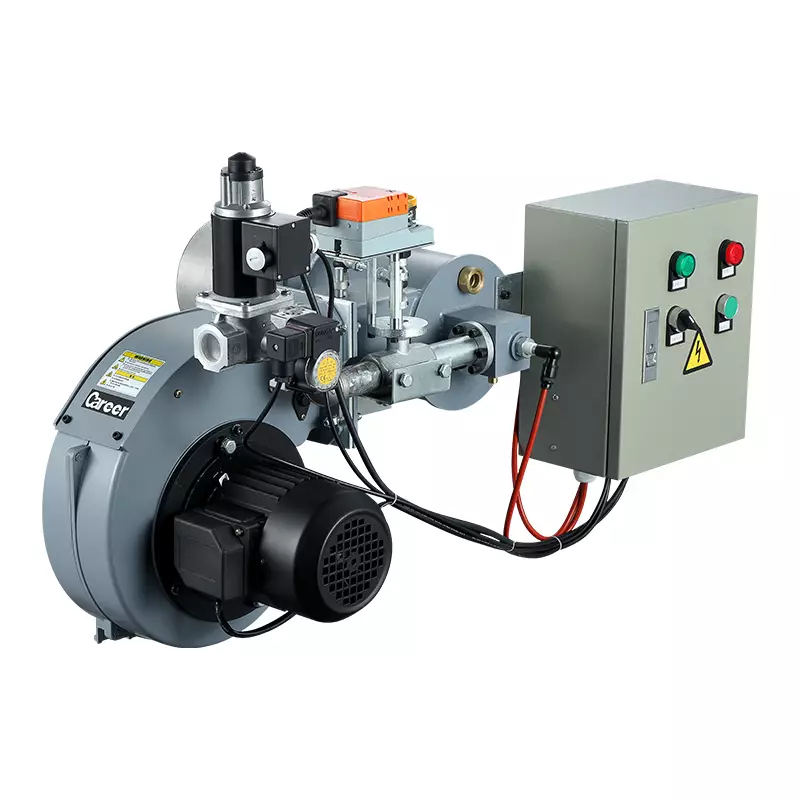
Burner turndown ratio describes how far a burner can reduce its firing rate relative to its maximum firing rate. Understanding that range helps engineers determine whether a burner can follow changing thermal demand effectively.
Turndown Ratio Describes the Burner’s Operating Range
Turndown is expressed as a ratio between maximum and minimum firing rates. A 10:1 ratio, for example, indicates that the maximum firing rate is ten times the minimum rate under the stated operating conditions.
The concept becomes particularly useful with a modulating gas burner because its output can change as process demand changes. Instead of treating full fire as the normal operating point, modulation provides a way to adjust heat input to the requirement.
Career Burner’s BX20 is specified with a 40:1 turndown ratio and continuous mechanical modulation. Its published output range is 5.3–232.2 kW, with natural gas consumption listed at 0.55–23.0 m³/h. These figures describe the product’s stated operating range rather than a universal performance standard for all burners.
A 40:1 Ratio Shows How Far Output Can Be Reduced
The BX20 provides a useful example of what a high turndown ratio means in practice. Its stated 40:1 modulating ratio means the burner is designed to operate across a substantially wider firing range than a burner restricted to a narrower modulation range.
The important point is that turndown is about range, not simply maximum capacity. Two burners could have similar maximum outputs while behaving very differently at low demand because their minimum stable firing rates are different.
BX20 uses mechanical continuous modulation, with a servo motor and mechanical linkage for load adjustment. Its specification also identifies automatic control and fuel/air flow regulation. Together, these features are intended to coordinate burner output with changing operating requirements.
Continuous Modulation Changes How Heat Demand Is Managed
Thermal demand can move gradually rather than jumping directly between full load and zero load. Continuous modulation gives the burner a way to follow those changes more progressively.
Consider an immersion heating system. If the required heat input falls, reducing burner output can maintain the process closer to its required condition. A narrow operating range may instead require more frequent cycling, depending on the control strategy and equipment design.
The BX20 is specifically described as an immersion tube burner for indirect liquid heating. Combustion occurs inside a submerged tube, transferring heat through the tube wall rather than bringing the flame directly into contact with the heated fluid. Its continuous modulation is therefore relevant to applications with dynamic heat loads.
Why Turndown Matters in Real Thermal Processes
A high turndown ratio becomes valuable when process demand varies significantly. Textile dyeing and finishing can involve changing thermal requirements, making precise adjustment of heat input more useful than simply operating at maximum firing rate whenever heat is required.
The BX20 is designed for natural gas or LPG and is identified by Career Burner for textile dyeing applications. Its published product information emphasizes dynamic heat loads and flame stability alongside the 40:1 turndown specification.
Greater modulation can also make temperature control easier to manage because the burner has more room to adjust its firing rate. However, the actual result depends on the complete heating system, including process controls, heat-transfer characteristics, chamber conditions, and the required operating range.
What the Ratio Does Not Tell You
Turndown should never be treated as a complete measure of burner quality. A large ratio does not by itself establish combustion efficiency, emissions performance, heat-transfer effectiveness, or suitability for a particular furnace or heating process.
Minimum firing conditions are especially important. An engineer needs to know whether the burner can maintain a stable flame at the lower end of its stated range and whether that minimum output matches the actual minimum heat demand of the equipment.
Other specifications also need to be considered. The BX20 includes forced-draft air supply, flame detection, pressure monitoring, valve leak detection, automatic and emergency shut-off, and automatic fuel/air regulation. These features address different aspects of operation and should not be conflated with the turndown ratio itself.
How to Judge Turndown for a Specific Installation
Start with the thermal load profile rather than selecting a ratio in isolation. Identify the maximum heat requirement, the normal operating load, and the lowest sustained demand that the process is likely to impose.
Next, compare that demand with the burner’s published minimum and maximum firing rates. A burner whose minimum output is still substantially above the process requirement may cycle more than desired, even if its maximum capacity appears suitable.
Control method matters too. A continuously modulating burner behaves differently from equipment that relies on discrete stages. Fuel type, combustion-air arrangement, heat-transfer system, and process-control strategy should all be evaluated together.
Career Burner’s BX20 combines continuous modulation with a stated 40:1 ratio, a 5.3–232.2 kW output range, and natural-gas or LPG operation. Those specifications make it a concrete example of how a burner can be configured for changing heat loads, but they should always be assessed against the actual installation.
Why the Right Ratio Depends on the Process
Turndown ratio matters because industrial heat demand is not always constant. A wider modulation range can give a burner more flexibility to reduce firing as demand falls, while continuous modulation can provide more gradual adjustment than fixed firing or limited-stage operation.
Our evaluation therefore begins with the process load profile, not with the largest turndown number available. The useful question is whether the burner’s minimum and maximum firing rates align with the real operating envelope.
Career Burner’s BX20 demonstrates this principle with its published 40:1 continuous modulation and 5.3–232.2 kW output range.
A turndown ratio is ultimately a practical measure of operating flexibility. Once engineers compare it with actual process demand, minimum load, control requirements, and burner stability, the number becomes much more meaningful for equipment selection.