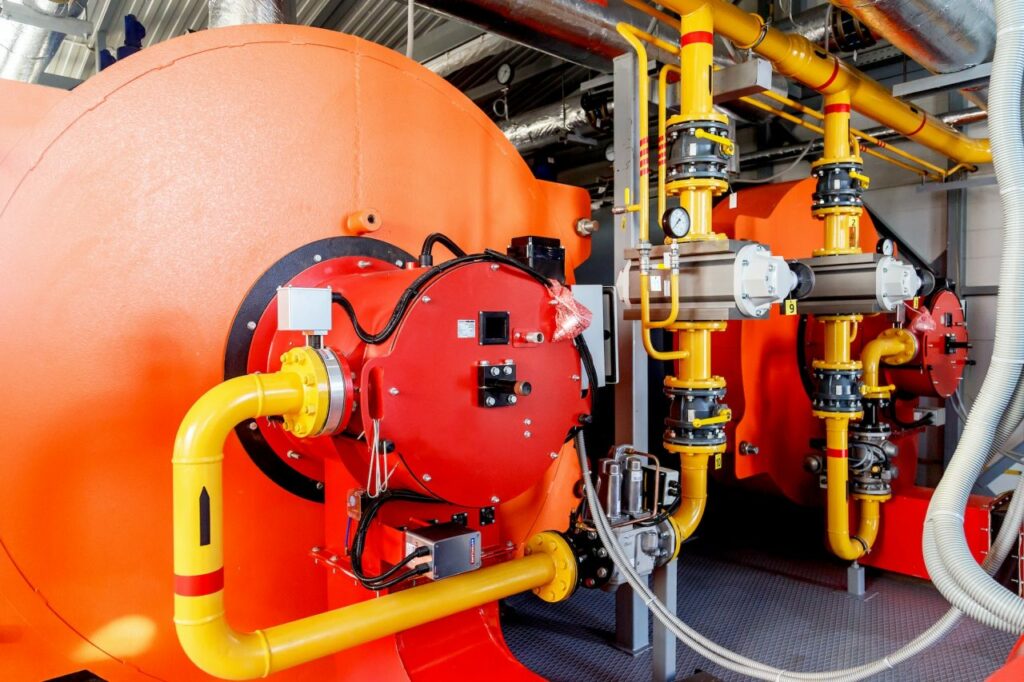
Industrial combustion equipment is the hardware used to convert the chemical energy of a fuel into controlled thermal energy for an industrial process. At its center is a burner, but the complete system can also include fuel trains, combustion-air equipment, ignition components, flame monitoring, control devices, and the chamber or process equipment receiving the heat.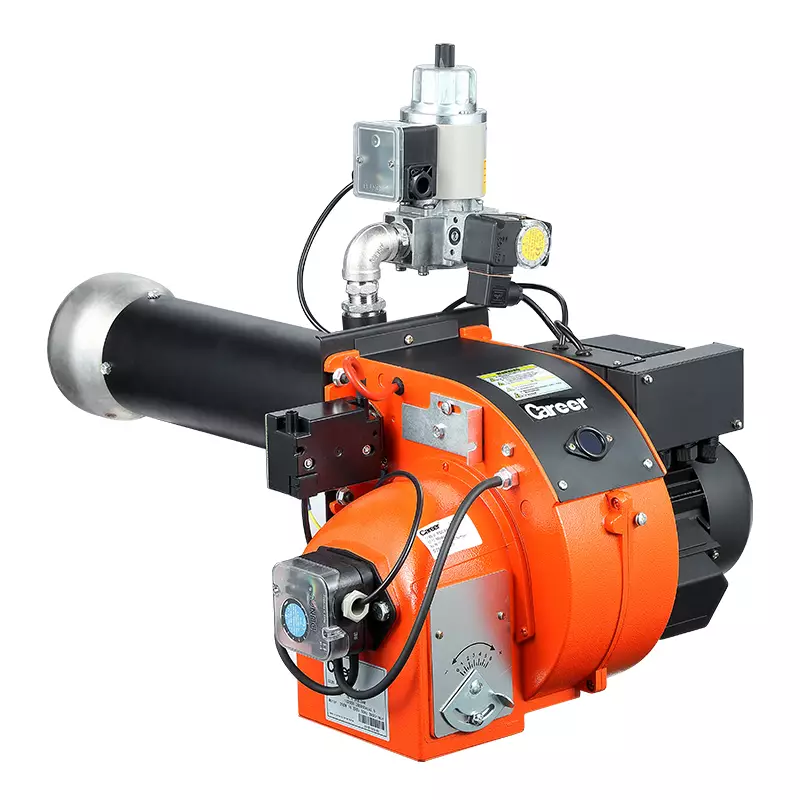
Ensuring stable heating performance requires looking at the entire heat-generation chain rather than treating equipment as standalone machines—from proper fuel delivery and controlled air supply to reliable ignition and flame stability under changing conditions.
To support this integrated philosophy, we at Career Burner offer a diverse product range covering oil, gas, methanol, waste-oil, and low-NOx burner configurations.
What Industrial Combustion Equipment Actually Includes
A typical industrial combustion installation begins with the fuel-handling side. Depending on the application, that may involve pumps, valves, regulators, filters, fuel lines, or other components needed to deliver fuel consistently to the burner.
Combustion air forms the second essential stream. Fans, dampers, and related controls supply air for combustion and help establish the conditions required for a stable flame. The burner brings these streams together in a controlled manner.
Ignition and flame supervision are equally important. An ignition system initiates combustion, while flame-detection equipment verifies that a flame is present. Gas burner systems, for example, can incorporate flame detection and pressure monitoring as part of their operating controls.
The final part is the heat-receiving equipment. Depending on the process, combustion equipment can supply heat to boilers, ovens, dryers, furnaces, kilns, or other thermal systems. Consequently, burner selection cannot be separated from the equipment being heated.
How Fuel and Air Become Controlled Heat
The operating principle is straightforward, but the engineering behind it requires precise control. Fuel enters the burner while combustion air is introduced through a separate air path. The burner creates the conditions needed for the two streams to mix and ignite.
Once ignition occurs, the flame releases heat through combustion. That thermal energy is then transferred into the surrounding process equipment, either directly through the flame and hot gases or indirectly through a heat-transfer arrangement.
Combustion quality depends heavily on the relationship between fuel and air. Too little air can interfere with complete combustion, while excessive air can carry additional heat out with the exhaust gases. Actual operating requirements vary according to fuel, burner design, chamber conditions, and process demand.
Our role is therefore not simply to deliver fuel to a flame. We need to produce a controllable combustion pattern that matches the thermal duty. That distinction becomes particularly important when a process repeatedly moves between low and high heat demand.
Where the Burner Fits Into the System
The burner is the point where the fuel and combustion-air systems become an active heat source. Its design influences how fuel is introduced, how air enters, how the flame forms, and how consistently heat is released.
Different fuels require different combustion arrangements. Oil burners commonly rely on atomization to convert liquid fuel into droplets suitable for combustion. Gas burners instead introduce gaseous fuel into the combustion zone, while other fuel types require their own handling and mixing arrangements.
A combustion burner may also be designed for different levels of output control. Some systems operate at defined firing stages, while modulating designs adjust heat input in response to process demand. Career Burner, for example, lists a BX20 immersion-tube burner with a 40:1 turndown ratio for applications requiring dynamic heat adjustment.
How Industrial Combustion Is Controlled During Operation
Industrial heating rarely requires exactly the same heat input throughout an entire production cycle. A boiler may respond to changing steam demand, while a dryer or oven may need adjustments as material conditions change.
Control systems respond by regulating fuel flow, combustion air, or both. Flame modulation can reduce or increase firing intensity instead of repeatedly operating at maximum output. This gives the thermal system a way to follow changing process requirements.
Monitoring provides another layer of control. Pressure sensors, flame detection, and automatic control logic can help the system respond to abnormal operating conditions. The precise control architecture depends on the burner and the process, so equipment should be evaluated as a complete operating package rather than by burner capacity alone.
What Determines Whether the System Performs Properly
Fuel characteristics are one starting point. Gas composition, liquid-fuel properties, and available fuel pressure can influence how the burner must be configured. Process conditions matter just as much because chamber temperature, back pressure, heat demand, and available combustion space affect flame behavior.
Air distribution deserves particular attention. Stable combustion requires the air and fuel streams to interact in the intended way. Changes to fans, dampers, ducting, or chamber geometry can therefore affect an existing burner installation.
Heat demand is another practical variable. A burner selected only around maximum output may not necessarily provide the desired control at lower loads. Turndown capability, flame stability, and the operating range of the process all deserve consideration during equipment selection.
Why Burner Configuration Matters to Industrial Heating
Two systems can use the same fuel while requiring very different combustion equipment. A boiler, drying system, textile process, and incineration system each impose different requirements on flame location, heat distribution, control response, and operating conditions.
Industrial combustion equipment works effectively when these factors are considered together. Our approach at Career Burner is to match burner technology with the actual thermal process, fuel, and required control behavior rather than treating burner capacity as the only selection criterion.
Understanding that relationship also makes equipment evaluation easier. Instead of asking only how much heat a burner can produce, we can ask how the complete combustion system delivers, controls, and transfers that heat under real operating conditions.
Conclusion
Industrial combustion equipment is essentially a controlled interface between fuel, air, ignition, flame management, and industrial heat demand. The burner creates the combustion process, while the surrounding fuel, air, control, monitoring, and heat-transfer components determine how that process operates within the plant.
For engineers evaluating a system, the most useful starting point is therefore the complete thermal duty: identify the fuel, required heat input, operating range, process conditions, and control requirements first. From there, the appropriate combustion equipment can be selected around the process rather than forcing the process to fit the burner.