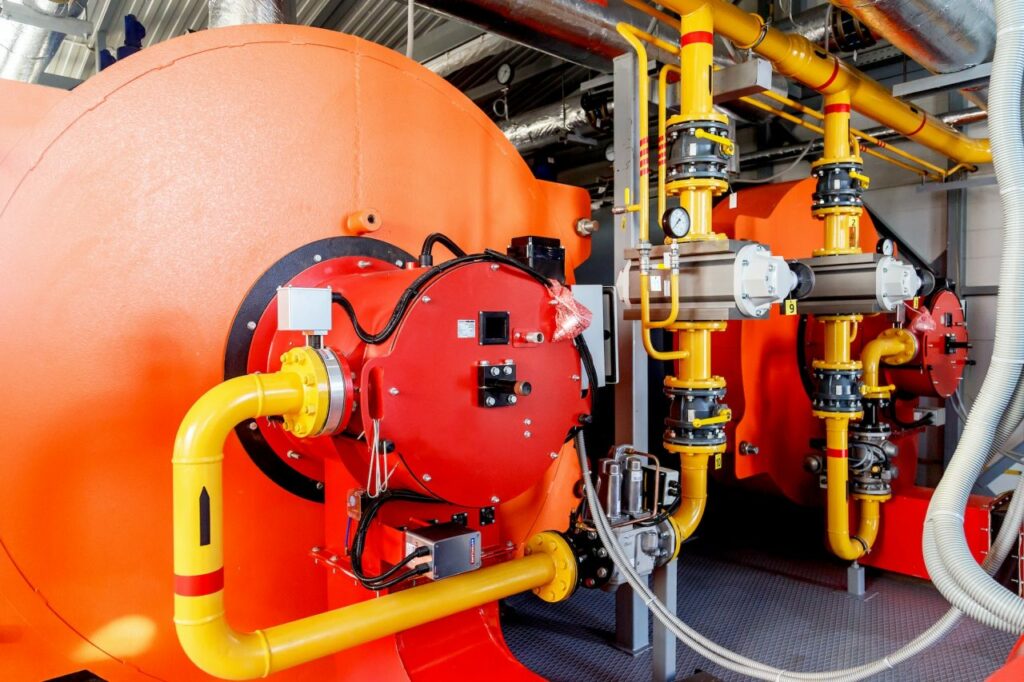
A facility operator notices that steam pressure in the boiler bounces erratically between setpoint during the morning production run. The burner fires at full capacity, reaching target in minutes, then shuts off completely.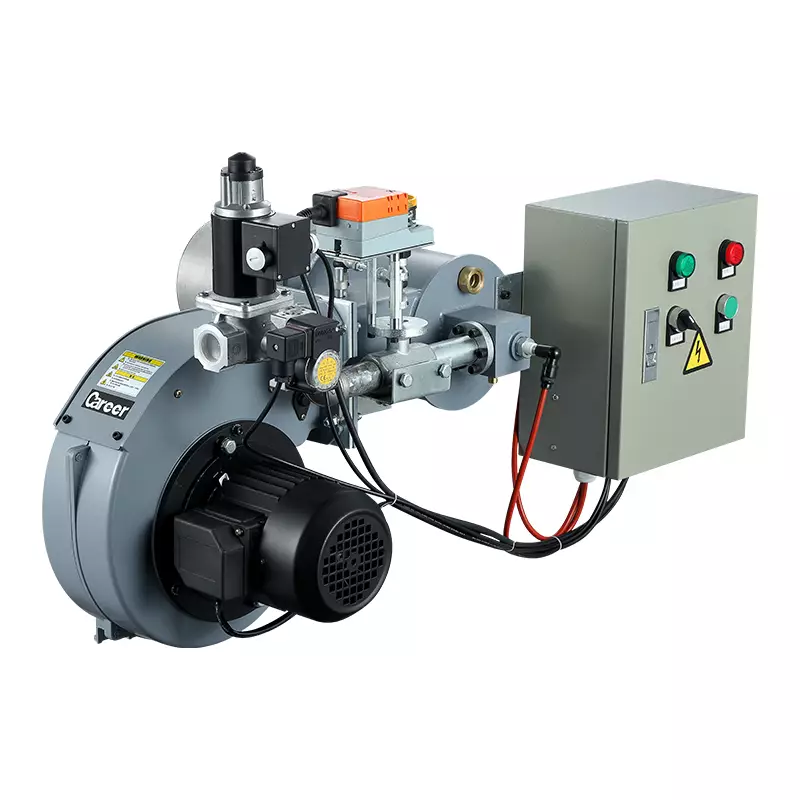
Pressure climbs, the burner ignites again, repeats. This cycling pattern is the signature of a single-stage burner—a device with no middle ground between maximum fire and complete shutdown.
By contrast, a modulating burner continuously adjusts output to match load demand, delivering steady thermal conditions that never require violent cycling. Understanding this architectural difference helps operators select equipment that genuinely matches their facility’s heating profile.
The Fundamental Control Difference
Single-stage and modulating burners represent two entirely different approaches to combustion control. A single-stage burner operates in binary mode: fuel flows and the flame ignites, or fuel stops and combustion ceases.
There is no intermediate state. When the system reaches target temperature, the burner shuts off. When demand resumes, it fires at full capacity again. This simplicity appeals to budget-conscious purchasers, but it forces the downstream equipment—boiler, furnace, heat exchanger—to absorb the consequences of constant thermal cycling.
A modulating burner, by contrast, automatically adjusts fuel and air supply to match the system’s instantaneous heating demand. As load decreases, the burner throttles down proportionally. As demand increases, output rises smoothly.
The flame never extinguishes; the system never cycles. This continuous adjustment requires a more sophisticated control mechanism, but it fundamentally changes how the equipment behaves during operation.
Single-Stage Burners: On-Off Simplicity and Its Costs
Single-stage burners excel in applications where heating demand is constant or nearly constant—a fixed-load furnace, a continuous drying oven, a process that runs at steady output hour after hour.
In these scenarios, the burner fires once per shift, runs at full capacity while the process operates, and shuts down at day’s end. Cycling is minimal because demand never fluctuates.
But real industrial heating rarely works that way. Production runs vary in intensity. Morning startup requires more heat than mid-day operation. Scheduled maintenance or product changeovers lower demand temporarily. Ambient temperature shifts affect the load profile. In facilities with variable demand, a single-stage burner becomes locked in a punishing cycle.
It overshoots target, shuts off, waits for pressure or temperature to drop, fires again at maximum, overshoots once more. Each cycle introduces thermal stress on the pressure vessel, causes inefficient combustion during ignition ramp-up, and consumes energy that produces no useful heating.
The burner operator cannot moderate this behavior through normal controls. Ourequipment is designed to be either fully on or fully off. Attempts to reduce fuel pressure or air supply typically result in incomplete combustion, carbon formation, and flame instability—worse problems than cycling itself.
How Modulating Burners Respond to Load Changes
A modulating burner uses a servo motor and mechanical linkage system to continuously adjust fuel and air supply proportional to the system’s thermal demand. As the controlled variable—steam pressure, hot water temperature, or furnace temperature—approaches setpoint, the burner’s control system reduces fuel flow.
As demand increases, fuel supply rises. The adjustment is smooth and continuous, happening every few seconds based on real-time feedback from sensors.
At Career Burner, our BX20 modulating immersion tube burner exemplifies this approach. Our burner features a servo motor that positions a fuel valve and air damper in concert with each other. When the system is at light load, fuel supply drops to a minimum level that maintains stable combustion—typically 10–15% of maximum.
The flame remains lit, the pressure stays stable, and no cycling occurs. As production demand increases, the servo motor gradually opens the fuel valve and increases air supply together, maintaining proper combustion balance throughout the adjustment range.
The mechanical linkage ensures that fuel and air ratios remain synchronized across all load conditions. If fuel were increased without matching air supply, combustion would become incomplete. If air increased without fuel, the flame would cool or extinguish. The linkage system prevents these mismatches by coupling the two adjustments mechanically, so they change proportionally.
The Turndown Ratio: Why 40:1 Matters More Than Raw Power
A turndown ratio expresses the range between maximum and minimum sustainable output. A 40:1 turndown ratio means the burner can operate stably anywhere from minimum (1 unit) to maximum (40 units) output.
Our BX20’s 40:1 ratio translates to extraordinary flexibility—the burner can run at minimum load when demand is low, yet deliver maximum thermal output when production peaks, all without cycling.
This range is not merely a specification; it determines whether the burner matches your facility’s actual operating profile. A single-stage burner has no meaningful turndown—it is either producing maximum heat or zero heat.
A modulating burner with a 20:1 ratio accommodates a range, but still requires external load management if demand drops below 5% of maximum. A 40:1 ratio covers most industrial heating scenarios without requiring the operator to manually adjust setpoints or shut down equipment during low-demand periods.
The larger the turndown ratio, the wider the band of normal operation where the burner modulates smoothly rather than cycles. For facilities with seasonal variations, production schedule changes, or multiple concurrent heating circuits, a high-performance burner with a wide turndown range becomes essential to avoiding the cost and wear penalties of constant on-off cycling.
Selecting Based on Real Operating Conditions
Choosing between single-stage and modulating burners requires honest assessment of your facility’s actual load profile, not theoretical maximum demand. If your heating load remains constant throughout the operating day, a single-stage burner may be sufficient and will carry a lower initial purchase price.
If demand fluctuates—morning startups at full capacity, afternoon transitions to part-load, evening shutdown ramps—a modulating burner is the correct choice despite higher upfront cost.
We at Career Burner work with industrial customers to evaluate their specific heating patterns and recommend the appropriate control architecture. For textile dyeing, where temperature precision and load variability define the process, a high-performance burner like our BX20 delivers the steady thermal control that single-stage equipment simply cannot provide. For other applications with less demanding load profiles, simpler equipment may be justified.
The decision ultimately hinges on what your production schedule actually demands, not on generic advice to “always buy modulating” or “single-stage is cheaper.” Modulating burners cost more initially but eliminate the operational penalties of cycling, extend equipment life, and enable tighter process control.
Single-stage burners cost less to purchase but impose hidden costs in the form of thermal stress, shortened component life, and energy inefficiency during cycling periods. Understanding this trade-off allows you to make a selection that genuinely serves your facility’s long-term efficiency and reliability.