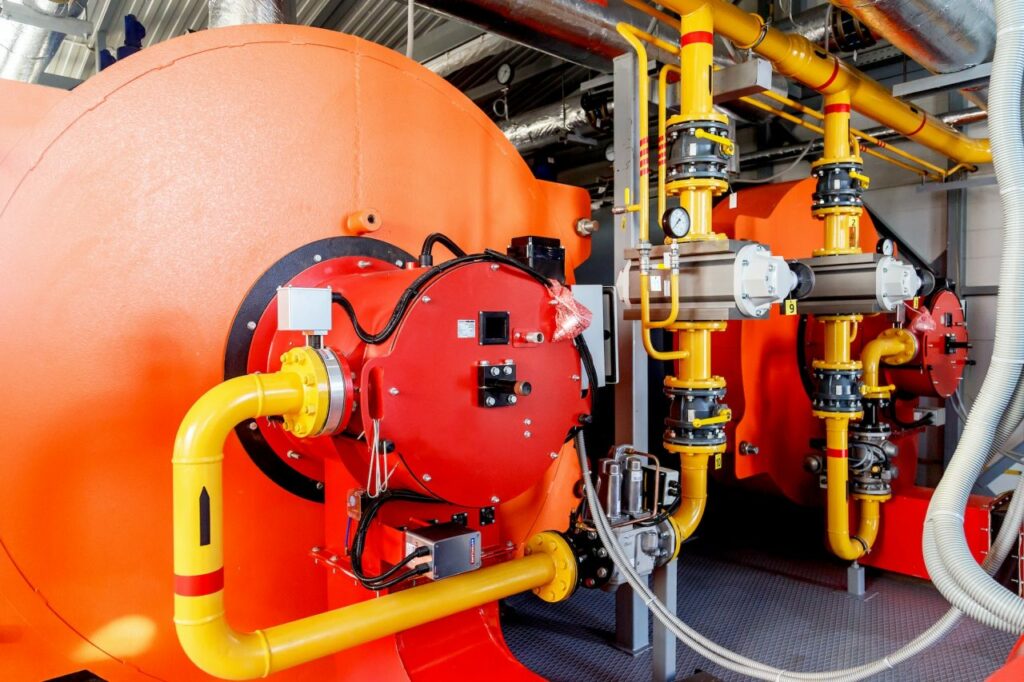
Installing an industrial natural gas burner requires a comprehensive review of your entire fuel ecosystem—from storage and delivery to mixing, ignition, and control systems—ensuring that your plant’s facility layout and process requirements are optimized for gas rather than oil.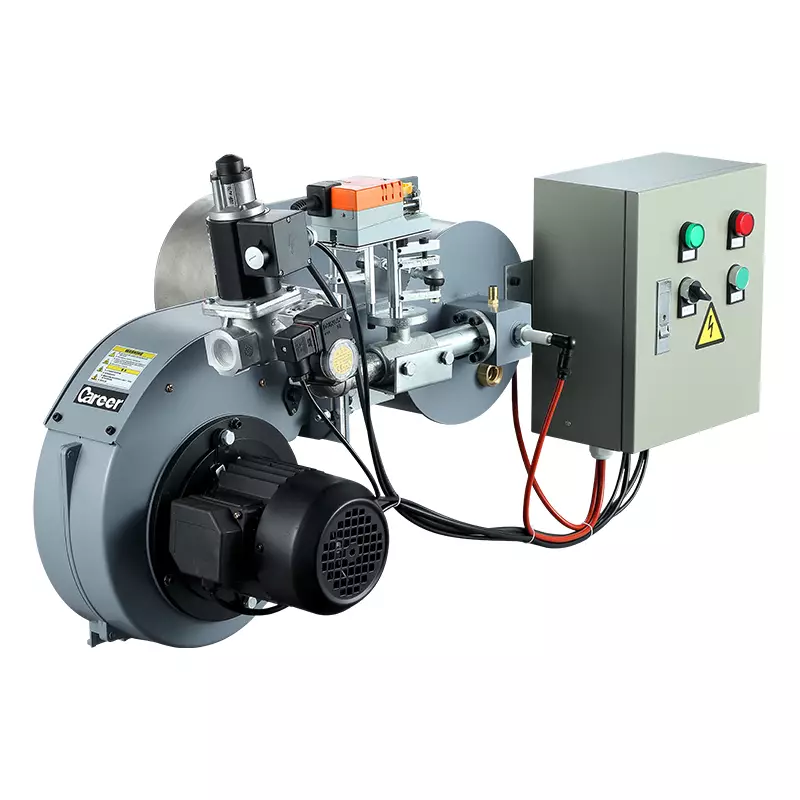
Oil remains a practical option where liquid fuel is readily available or where existing equipment is built around it. Gas, however, changes the operating model considerably. We see the distinction most clearly in fuel handling, flame control, emissions, and maintenance.
The Fuel Supply Changes the Burner Design
Natural gas reaches a burner as a gaseous fuel, so the combustion system can regulate fuel flow through gas-train components and controlled pressure. An oil-fired system instead has to move a liquid fuel and prepare it for combustion, typically through atomization. That difference affects the equipment surrounding the burner as much as the burner itself.
Our industrial gas systems use nozzle-mixing combustion for direct-fired applications. Fuel and air remain separate until they meet at the nozzle, producing a controllable diffusion flame. The design is intended for applications where stable combustion and substantial turndown are important.
Oil burners require a different combustion pathway because liquid fuel must be converted into sufficiently fine droplets before effective burning can occur. Fuel quality, viscosity, atomization, and nozzle condition therefore become part of the operating equation. Our oil-burner range, for example, covers diesel, kerosene, and Bio 10 oil, with outputs from 24 kW to 1,416 kW.
Combustion Behavior and Heat Control
A useful comparison starts with how precisely each burner can respond to changing process demand. Industrial furnaces, ovens, dryers, and other thermal equipment rarely operate at one constant load throughout an entire production cycle. The burner therefore needs to follow demand without creating unstable combustion.
A well-designed gas burner for industrial use provides responsive fuel control because the fuel is already gaseous. Career Burner specifies nozzle-mix industrial gas burners with turndown ratios up to 40:1, depending on the applicable model and configuration. Such modulation can be valuable where heat demand changes significantly during production.
Oil systems can also provide staged or modulating control. Their practical performance, however, depends on maintaining appropriate atomization and fuel delivery. That makes burner selection inseparable from the characteristics of the liquid fuel and the operating conditions of the installation.
Neither fuel automatically guarantees better thermal performance. Actual results depend on burner design, air-fuel control, furnace configuration, operating load, and tuning. A comparison based solely on fuel type can therefore lead to the wrong equipment decision.
Emissions and Combustion Cleanliness
Emissions are one of the clearest technical differences between the fuels, particularly for facilities managing particulate matter and sulfur-related pollutants. EPA documentation notes that natural gas combustion has very low particulate emissions compared with many other fossil fuels, while nitrogen oxides remain an important combustion pollutant that requires attention.
Oil combustion varies considerably according to the fuel grade. EPA information explains that lighter distillate oils generally produce less particulate matter than heavier residual oils, while sulfur oxide emissions are linked strongly to the sulfur content of the fuel.
Consequently, an industrial natural gas burner can be attractive where minimizing particulate and sulfur-related emissions is a priority, but gas should not be treated as automatically low-NOx. Flame temperature, excess air, burner geometry, and combustion control still influence NOx formation.
Maintenance Starts With What Enters the Burner
Maintenance requirements also reflect the physical properties of the fuel. Gas systems do not require liquid-fuel atomization, and there is generally less concern about liquid nozzles becoming affected by fuel characteristics. That does not make gas burners maintenance-free: filters, gas pressure, burner components, flame detection, and combustion settings still require inspection.
Oil-fired equipment introduces additional components and operating variables associated with liquid fuel. Atomization equipment, fuel-flow control, and nozzles need appropriate attention because poor fuel preparation can affect flame quality and combustion completeness. EPA research similarly links oil particulate formation to combustion completeness and fuel characteristics.
Our experience is that maintenance should be evaluated as part of the complete combustion package rather than judged from the burner alone. Fuel storage, filtration, pumps, piping, controls, and access for servicing can materially affect the practical workload.
Choosing Around the Existing Plant
The stronger choice is ultimately determined by the plant rather than by a universal ranking of gas versus oil. Start with fuel availability. A facility with reliable natural-gas infrastructure may have a straightforward path toward gas combustion, while a site already equipped for liquid fuel may face additional conversion requirements.
Next, examine the process. Direct-fired ovens, dryers, textile equipment, food-processing systems, and similar applications can place different demands on flame geometry, turndown, temperature control, and burner installation. Our industrial gas portfolio is specifically designed for direct-fired applications including ovens, dryers, paint-finishing lines, textile and paper machinery, food-baking equipment, coffee roasters, grain dryers, and fume incinerators.
Finally, compare the complete installation rather than the burner purchase price. Fuel infrastructure, controls, storage, maintenance, emissions requirements, and future operating conditions all belong in the evaluation.
For a plant with accessible gas supply and a strong need for controllable, clean direct-fired combustion, gas can be the more practical route. Oil can remain appropriate where liquid-fuel infrastructure, availability, or process requirements make conversion unattractive. The best selection is the one that matches the combustion system to the plant’s actual operating envelope.
At Career Burner, we approach that decision from the application backward: required heat output, fuel conditions, control strategy, and installation environment first. That method gives engineers a more useful basis for choosing between gas and oil than comparing burner labels alone.