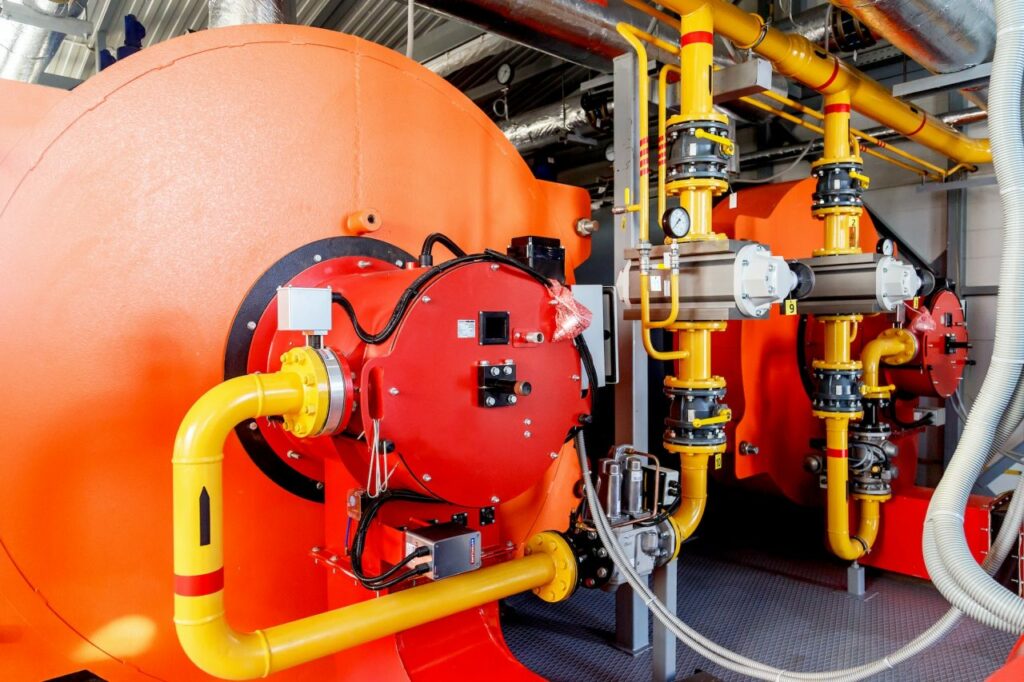
Industrial heating demands are rarely static. Furnaces typically require full firing power during startup, moderate output during active production, and significantly less energy once the target temperature is reached. The real engineering challenge lies not in simply altering burner output, but in adjusting it smoothly without sacrificing flame stability.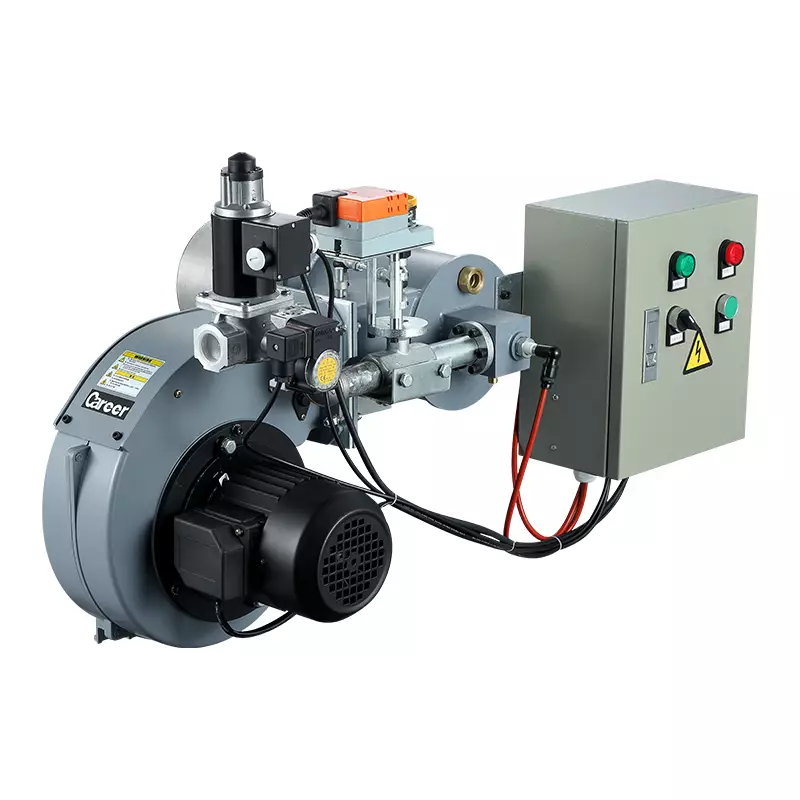
To safeguard combustion stability, we approach load fluctuations as a synchronized adjustment encompassing fuel delivery, airflow, flame dynamics, and control response. This ensures the burner consistently operates within a reliable window across both high and low firing rates.
A Load Change Alters More Than Fuel Flow
Reducing heat input does not simply mean sending less fuel through the burner. Combustion air also needs to respond, while the velocity and mixing conditions inside the flame change with firing rate.
If fuel and air do not remain appropriately matched, the flame can become unstable. Too little air can promote incomplete combustion, while excessive air can weaken the flame and increase heat carried away through the exhaust.
The combustion chamber introduces another variable. Furnace pressure, temperature, available combustion air, and surrounding surfaces influence how the flame behaves as output changes.
A stable burner therefore needs predictable behavior across its operating range. The target is not merely a high maximum capacity, but controlled transitions between different firing conditions.
Low Fire Is Where Stability Gets Tested
High firing rates generally provide strong fuel and air flows and a substantial heat-release zone. Low fire can be more demanding because flow velocities and the energy released by the flame are reduced.
At sufficiently low output, the flame may approach a condition where it can no longer remain properly anchored. Ignition reliability and flame detection can also become more sensitive to operating conditions.
This is why turndown is an important part of evaluating a modulating burner. A wide turndown range gives the combustion system more room to reduce heat input while maintaining stable operation, provided the burner has been designed and adjusted for that range.
Equipped with a 40:1 turndown ratio, the Career Burner BX20 immersion tube gas burner is well-suited for applications experiencing heavy load variations. This high turndown capability allows the system to modulate far below peak capacity, avoiding the wear and inefficiencies associated with frequent on-off cycling.
Air and Fuel Have to Move Together
Combustion stability depends heavily on the relationship between fuel and combustion air. During a load transition, both flows need to respond in a controlled manner rather than changing independently.
The required relationship is not necessarily identical at every firing rate. Burner geometry, fuel characteristics, air pressure, and mixing design all influence how the flame responds as output changes.
A practical control system therefore needs to maintain the intended combustion relationship while the burner moves through its firing range. Measurement and commissioning are important because the actual installation can behave differently from an idealized calculation.
Operators can monitor indicators such as flame appearance, combustion measurements, fuel and air pressures, and exhaust conditions to identify whether the burner remains within its intended operating window.
This coordinated behavior is especially important when the process changes quickly. A slow or poorly matched control response can temporarily push the combustion system away from its stable condition even if the burner performs correctly at steady state.
Flame Shape Has to Survive the Transition
Flame stability is not determined by chemistry alone. The physical shape and movement of the flame matter because the burner must release heat in a way that suits the surrounding equipment.
Immersion tube systems provide a useful example. The flame develops inside a tube, where combustion conditions and heat transfer are closely connected. Changes in firing rate therefore affect not only combustion but also how thermal energy is transferred to the process.
The BX20 is presented by Career Burner as an immersion tube burner for industrial applications, including textile heating.
A high temperature burner can likewise face demanding conditions because the surrounding thermal environment can influence component temperatures and flame behavior. Selecting the burner without considering chamber geometry or heat-transfer arrangements can make stable operation more difficult.
Control Range Matters More Than Peak Output
A burner rated for a very high output may look attractive during equipment selection, but its peak rating does not describe how effectively it handles changing loads.
The more useful question is how the burner performs between maximum and minimum firing. Can it reduce output smoothly? Does the flame remain anchored? Can the control system respond quickly enough to changes in process temperature? Does the heating equipment require continuous modulation or another firing strategy?
These questions define the usable operating range.
Load characteristics should therefore be established before selecting the burner. Startup demand, normal production demand, minimum process load, temperature recovery, and expected cycling all influence the required control range.
We consider those conditions together rather than treating turndown as an isolated catalogue specification. A burner with an appropriate operating envelope is more likely to maintain predictable combustion as production changes.
We Match Load Behavior to the Heating Equipment
Stable combustion begins with understanding what the burner is expected to do. A system with slow thermal changes may not require the same response characteristics as equipment where temperature demand changes rapidly.
Our selection process considers the relationship between burner output and the thermal behavior of the application. Fuel supply, combustion-air conditions, chamber design, required temperature, and control strategy all contribute to the final operating envelope.
Career Burner supplies combustion equipment for industrial thermal applications where controlled heat delivery is required.
The central principle is straightforward: stable combustion across different loads requires the burner to remain inside a controllable and physically suitable operating range. Fuel and air must remain properly coordinated, the flame must stay anchored, and the control system must respond appropriately as demand changes.
That is why load stability should be evaluated across the complete firing range rather than demonstrated only at maximum output. For industrial heating equipment, reliable performance comes from matching the burner’s combustion characteristics to the way the process actually consumes heat.