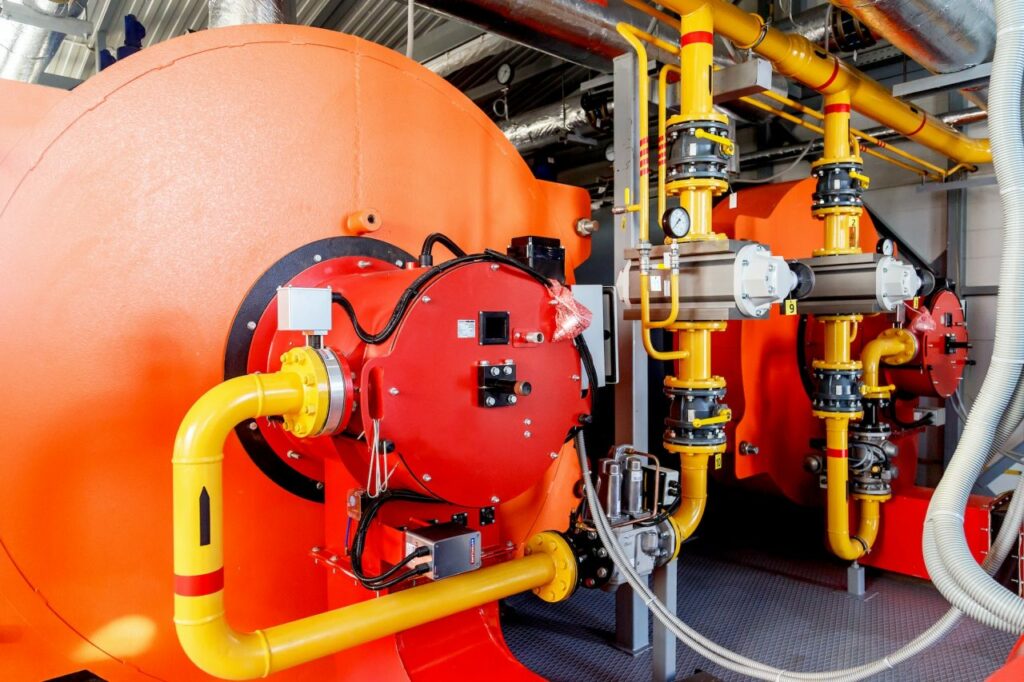
When evaluating combustion equipment for your facility, the distinction between burner types goes beyond manufacturer labels—it directly influences your system’s efficiency, turndown capability, emissions profile, and maintenance requirements. We recognize that plant engineers making this decision need clarity on what separates one design from another and how each performs under real operating conditions.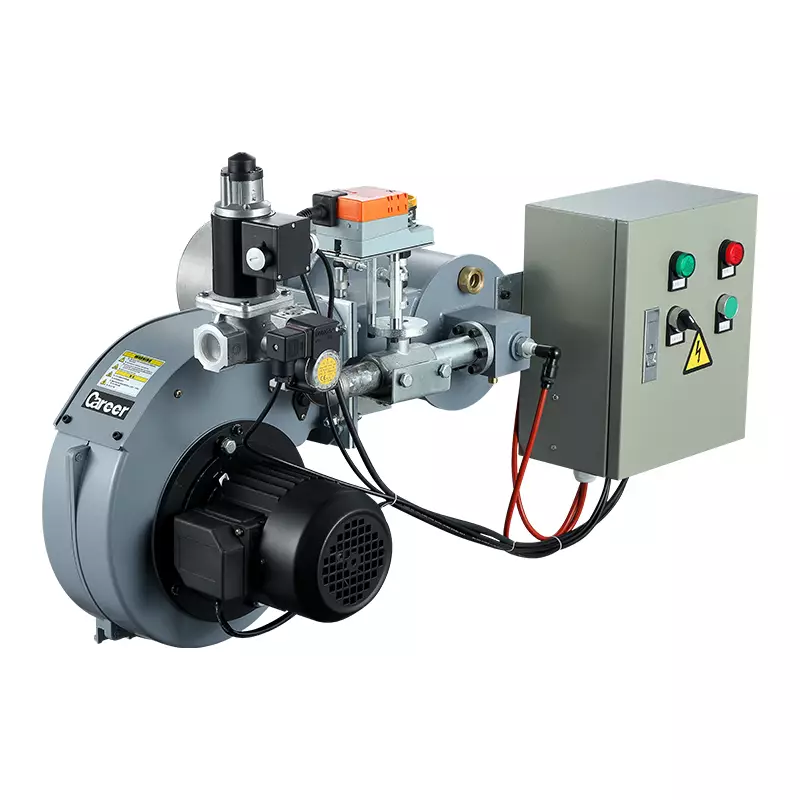
Why Burner Type Matters to Your Process
Industrial gas burners aren’t interchangeable. The core difference lies in how fuel and air combine before ignition, and this mixing approach determines flame stability, modulation range, and suitability for varying load conditions. A burner optimized for steady-state boiler operation behaves differently from one engineered for processes requiring frequent load swings—like textile stenter systems or paint drying ovens.
Career Burner focuses on application-specific solutions because selecting the wrong type creates hidden costs: oversized equipment runs inefficiently, undersized capacity forces you to operate beyond safe margins, and poor flame control leads to product quality issues and higher emissions compliance risk. Understanding the main types of industrial gas burners helps you match equipment to actual process demands rather than settling for generic options.
Nozzle-Mix Burners: Precision Control for Industrial Heating
Nozzle-mix design represents the foundation of modern industrial combustion control. In this configuration, fuel gas and combustion air remain separate throughout the burner tube, mixing only at the exit nozzle where the flame forms. This delayed mixing creates a diffusion flame—a stable, flexible combustion zone ideal for applications with variable heat demand.
The practical advantage is exceptional turndown ratio. Nozzle-mix burners typically achieve high turn-down ratios (up to 40:1), meaning they modulate smoothly from minimal firing to full capacity without flame instability, oxygen enrichment, or emission spikes. This matters in textile stenters, paper machinery, and food processing, where process temperature must respond dynamically to product flow and ambient conditions.
Career’s BX series nozzle-mix burners range from 5.3 kW to 348.3 kW and accommodate natural gas, LPG, and biogas interchangeably—a flexibility that premixed designs cannot match. The nozzle-mix approach also minimizes flashback and backfire risk by maintaining fuel-air separation longer, enhancing safety in installations where flame stability monitoring matters.
Premixed Burners: Compact Efficiency for Steady-State Loads
Premixed burners combine fuel and air in a separate plenum before entering the combustion chamber, creating a homogeneous gas-air mixture at the ignition point. This produces a more compact, higher-temperature flame with lower spatial footprint—an advantage in space-constrained applications like small ovens or portable heating units.
The trade-off is reduced modulation flexibility. Premixed systems typically operate effectively across a narrower turndown range, often 4:1 to 10:1, making them better suited to processes with relatively stable heat demand. If your application demands frequent load swings, premixed burners become inefficient and may develop flame instability at reduced firing rates.
They also offer simpler construction and lower material cost, which appeals to budget-sensitive applications where product specifications don’t require dynamic thermal control. However, they’re more sensitive to air supply variations and upstream pressure fluctuations, requiring tighter maintenance discipline to preserve performance.
Atmospheric Burners: Simplicity for Non-Demanding Applications
Atmospheric burners rely on natural draft (stack effect) and ejector principles to draw combustion air into the burner, eliminating the need for forced-air fans. They represent the simplest, lowest-cost entry point to industrial gas combustion and remain common in legacy installations, infrared heaters, and low-pressure applications.
The fundamental limitation is absence of active air control. Without a forced-air system, you cannot precisely modulate oxygen supply or achieve tight combustion stoichiometry. Emissions performance is mediocre compared to nozzle-mix or premixed systems, and turndown is typically minimal (often 2:1 or less). Atmospheric burners work well for permanent, unchanging loads but fail in applications where process conditions vary.
Choosing the Right Type for Your Industrial Demand
Selecting a burner type begins with understanding your load profile. If your process experiences variable heat demand throughout the operating day, and especially if you want to minimize NOx emissions while maintaining flame stability, nozzle-mix design offers the control and flexibility that industrial gas burners require. The industrial gas burner category includes all three types, but they serve fundamentally different missions.
Cost and space constraints sometimes favor premixed or atmospheric designs, but accepting reduced modulation to save capital often costs more in inefficiency over the equipment’s life. We’ve found that facilities installing the right type initially—even at higher upfront cost—achieve faster ROI through reduced energy consumption and fewer emission violations than those retrofitting undersized or mismatched equipment.
Your fuel source, pressure availability, and emissions regulations also narrow the field. Career Burner evaluates these factors alongside your specific application, ensuring the selected type aligns with both current needs and future flexibility as production demands evolve.