Industrial heating rarely runs at one constant load. A dryer may demand more heat as wet material enters, then less as the process approaches its setpoint. If burner output changes only in large steps, temperature can oscillate, causing uneven processing and unnecessary fuel use. We treat combustion output as a controllable part of the temperature loop, rather than simply a source of maximum heat.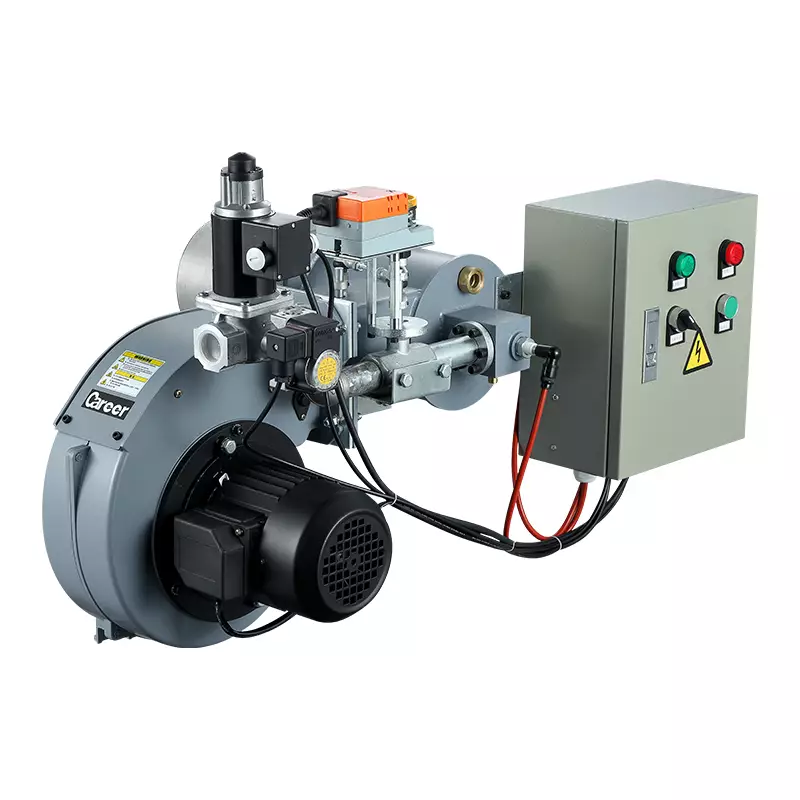
Match heat input to the actual process load
Temperature control starts with one basic relationship: heat entering the process must follow heat leaving it. Full-fire operation can push temperatures above target as demand falls, while on/off firing can create repeated swings.
A modulating gas burner addresses that mismatch by continuously adjusting firing rate. The BX20, for example, uses mechanical continuous modulation and a 40:1 turndown ratio. Its servo motor and mechanical linkage adjust the load, while automatic fuel and air flow regulation supports the combustion change. This gives the control system a finer way to respond to changing thermal demand.
Use turndown where temperature demand changes
Turndown matters when the process spends substantial time below maximum demand. A liquid-heating operation may need high output during heat-up but much less energy near its target. A burner with limited turndown may be forced into repeated starts and stops, or may struggle to maintain a low, stable firing rate.
The BX20 is designed around this type of dynamic load. Its stated output range is 5.3–232.2 kW, with natural gas consumption of 0.55–23.0 m³/h. The modulation range can bring heat input closer to actual demand. That distinction matters for stable temperature control.
Keep combustion changes synchronized
Fuel adjustment alone is insufficient. Air supply must remain appropriate as firing rate changes. Otherwise, the burner can move away from the intended combustion condition. Control architecture therefore has to coordinate fuel and air while maintaining a stable flame.
Our BX20 uses forced-draft air supply together with automatic fuel/air flow regulation. This is how a modulating gas burner can respond without abandoning flame control. The design also includes flame detection, pressure monitoring, valve leak detection, and automatic or emergency shut-off. These functions do not replace the process controller; they provide combustion-side control and protection as demand changes.
Indirect heating can protect the process
Heat-transfer configuration also influences temperature behavior. Direct flame contact is unsuitable for processes where combustion products must remain separated from the heated medium. An immersion tube arrangement transfers combustion heat through tube walls, allowing a burner to heat a liquid without firing directly into that fluid.
That configuration suits textile dyeing and finishing, where consistent liquid heating matters. The BX20 fires into compact immersion tubes, producing heat indirectly. Because the burner can continuously adjust its firing rate, heat supplied to the tube can follow changing process demand instead of relying only on full-fire operation.
Size the control range around real operating conditions
A burner should not be selected simply because its maximum capacity exceeds the calculated peak load. The lower end of its operating range matters when the process regularly runs at partial load. Excess capacity combined with insufficient turndown can make temperature regulation harder even though the burner appears powerful enough on paper.
We look at the complete operating window: required heat during startup, normal production load, minimum sustained load, fuel availability, combustion-air requirements, and how the process controller sends demand to the burner. For the BX20, natural gas or LPG can be used, and the published modulation mode is continuous. Those characteristics make operating range part of selection.
Control stability depends on the whole system
A highly adjustable burner cannot compensate for a poorly designed temperature-control system. Sensor placement, controller tuning, heat-transfer characteristics, burner response, and process residence time all affect how quickly the system reacts. If a temperature sensor is too far from the controlled zone, the controller may respond late and cause overshoot or cycling.
A high performance burner should therefore be evaluated as one element of the complete heating system. At Career Burner, we assess a high performance burner by how well it integrates with the process. We examine how the burner, combustion controls, heat-transfer equipment, sensors, and process controller interact under both high and low demand.
What this means for industrial heating
Better temperature control does not necessarily require a more complicated process. It requires heat input that can follow the process closely. Continuous modulation, coordinated fuel and air regulation, and an adequate turndown range give the control system room to make smaller adjustments instead of relying on abrupt firing changes.
Drawing on our extensive background in industrial combustion, we prioritize a burner’s full operating envelope rather than focusing solely on peak output. By integrating continuous modulation, a 40:1 turndown ratio, forced-draft air supply, and automated load tracking, the BX20 is engineered specifically for environments with shifting thermal demands. In applications like textile heating, these technical features ensure burner output closely mirrors real-time temperature control requirements.
Industrial burners only truly optimize temperature control when their turndown ratio, combustion dynamics, and control logic are custom-matched to the process. At Career Burner, our goal is simple: deliver precise thermal energy on demand, turning accurate modulation into a practical tool to stabilize your entire heating system.