Industrial heating processes rarely operate at maximum capacity continuously. Textile dyeing and finishing applications, for example, heat fabric to target temperature, then require only minimal heat input to hold that temperature as the process continues.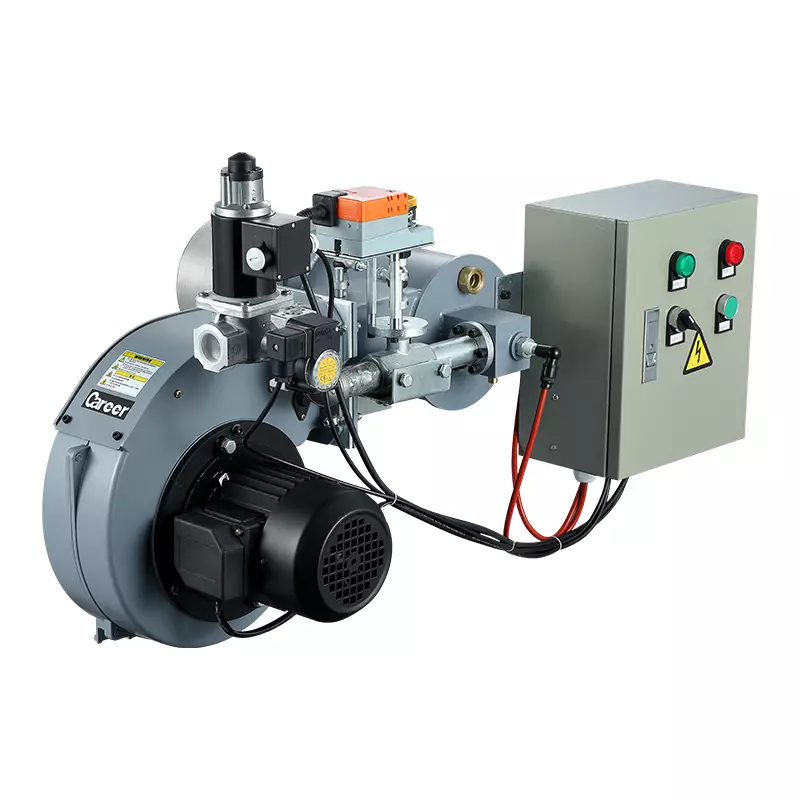
Fixed-capacity burners respond to this variability poorly: they fire at full output or shut down entirely, cycling repeatedly and wasting fuel in the process. Modulation eliminates this inefficiency by continuously adjusting flame intensity to match actual thermal demand.
The On-Off Cycle: Where Fixed-Capacity Burners Waste Energy
Non-modulating burners operate in binary mode: full fire or complete shutdown. Once a tank or chamber reaches setpoint, the thermostat kills the flame. Temperature drifts down, triggering reignition at full capacity again. This repetitive cycling wastes fuel through constant overshoot and cool-down cycles.
Each reignition event consumes excess energy: the burner fires at full intensity, raising temperature well above setpoint, then shuts down while the system cools. Over a production day with dozens of cycles, this translates to significant wasted fuel compared to a burner that fires once and maintains temperature continuously.
Shutdown also creates energy waste—when the burner shuts off, residual heat continues warming the fluid briefly, but reignition often occurs before that energy fully dissipates, causing temperature overshoot that repeats the cycle.
Modulation prevents this pattern by maintaining continuous flame. Rather than cycling on and off, the burner reduces intensity to match low demand. Flame never extinguishes, so no reignition energy waste occurs, and temperature drift becomes minimal. Continuous operation at variable output replaces the inefficient on-off pattern entirely.
How Modulation Continuously Adjusts to Changing Load
Modulating burners adjust fuel and air flow in real time without extinguishing the flame. A servo motor coupled to mechanical linkage proportionally adjusts fuel and air valve positions based on temperature feedback from the heated medium. Load increases trigger the servo upward, opening both fuel and air simultaneously; load decreases drive it downward, reducing both proportionally to maintain combustion stability.
At Career Burner, our BX20 modulating immersion burner achieves this through a 40:1 turndown ratio, enabling reliable operation from maximum fire down to minimum fire. At full capacity, natural gas consumption reaches 23.0 m³/h; at minimum fire, it reduces to 0.55 m³/h.
Throughout this entire range, the nozzle-mix design keeps fuel and air separate until the combustion point, ensuring stable flame and complete fuel burn.
This means the burner always fires at the load level your process actually needs. During holding phases when thermal demand is low, the burner settles at minimum fire and remains stable indefinitely. No cycling, no overshoot, no repeated ignition waste. Continuous modulation provides smooth, responsive control that binary burners cannot match.
Mechanical Continuous Modulation: Precision Without Drift
Modulating burners rely on accurate fuel-air ratio maintenance across their entire operating range. Career Burner‘s BX20 uses mechanical continuous modulation with servo motor and mechanical linkage to adjust both fuel and air simultaneously. This proportional adjustment ensures combustion stability at any firing rate within the 40:1 turndown range.
Mechanical linkage design maintains stoichiometric balance automatically, without electronic calibration that can drift over time. When the servo adjusts the fuel valve upward, it simultaneously opens the air valve by the same proportion. This coordinated adjustment prevents either fuel-rich or fuel-lean combustion, keeping flame stable and complete across all firing levels.
Low-fire operation particularly benefits from this precision. At extreme turndown levels, many burners struggle with flame instability. The BX20’s nozzle-mix design and mechanical linkage maintain reliable operation even at these low firing rates, ensuring efficiency gains persist during low-demand periods when energy waste typically peaks.
Efficiency in Textile Finishing: Where Modulation Excels
Textile dyeing and finishing operations demonstrate modulation’s efficiency value clearly. Fabric processing requires heated water at stable temperature for extended holding periods. Initial heat-up demands significant burner output ranging from 5.3 kW to 232.2 kW depending on tank size and heating time. Holding phase requires only maintenance heat input to offset ambient losses.
A modulating gas burner like the BX20 fires at high intensity during heat-up, then throttles back to low fire during the holding phase. The burner never cycles on and off; it remains lit but fires at whatever level the process demands. This continuous operation eliminates the repetitive waste of cycling burners while maintaining precise temperature control throughout the process.
Facilities operating multiple textile stenters benefit compounded savings when upgrading from fixed-capacity to modulating systems. Each burner that shifts from on-off cycling to continuous modulation reduces daily fuel consumption. The cumulative effect across several processes makes modulation particularly valuable in textile manufacturing, where variable heat demand and long holding periods define typical operation.
When Modulation Makes Economic Sense
Modulation efficiency gains depend on your process’s duty cycle and thermal load variability. Applications with constant maximum demand throughout operation see minimal modulation benefit—the burner remains at full fire regardless. Applications with significant load swings—textile dyeing, batch processing, intermittent heating—capture significant efficiency improvements.
Evaluate your facility’s actual firing pattern. If your burner operates continuously but at varying capacity, modulation addresses exactly this scenario. If your process demands full-capacity heat input throughout operation with minimal load variation, standard fixed-capacity burners may prove more economical. Understanding your specific application’s load profile determines whether modulation investment justifies the cost.
The BX20’s dual-fuel compatibility with natural gas and LPG, combined with advanced safety systems including flame detection and pressure monitoring, makes it well-suited to industries where continuous but variable heating defines the work. Textile operations and similar applications operate at stable setpoint temperature but with thermal demand that fluctuates throughout the production cycle.
For these applications, immersion burner modulation transforms fuel consumption from wasteful on-off cycling into precise, continuous adjustment that tracks process demand directly, delivering measurable energy savings through responsive thermal control.