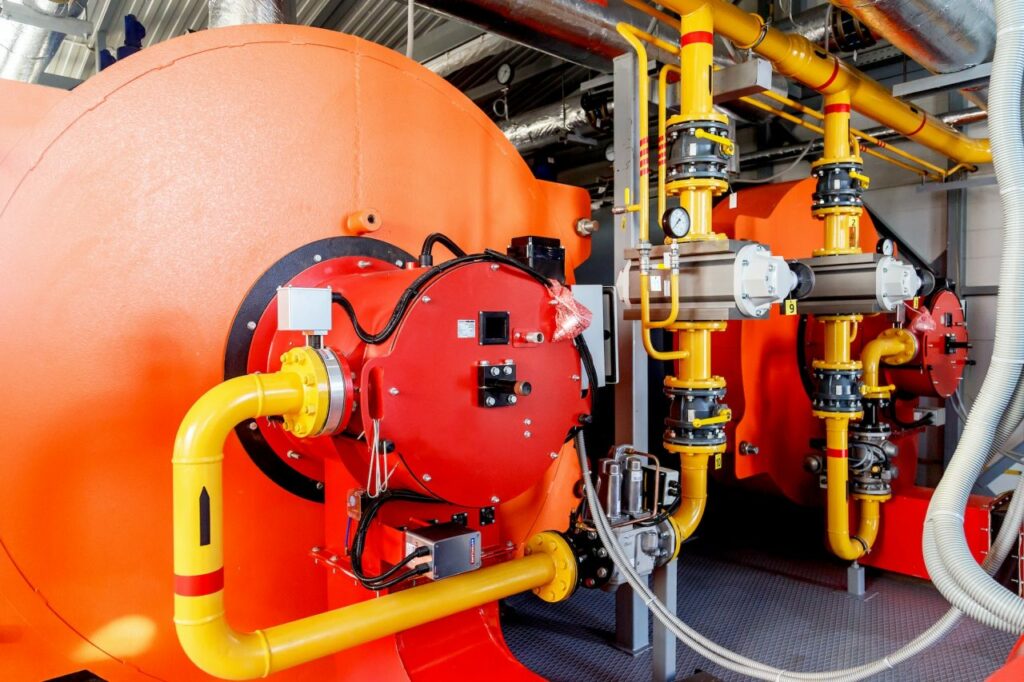
Industrial gas burners are the point where fuel, air, ignition, and process heat come together. Yet knowing that a burner produces heat does not explain what happens inside the combustion zone or why burner design matters. How a burner meters fuel and air, mixes them, establishes a flame, and responds to changing demand is the practical question.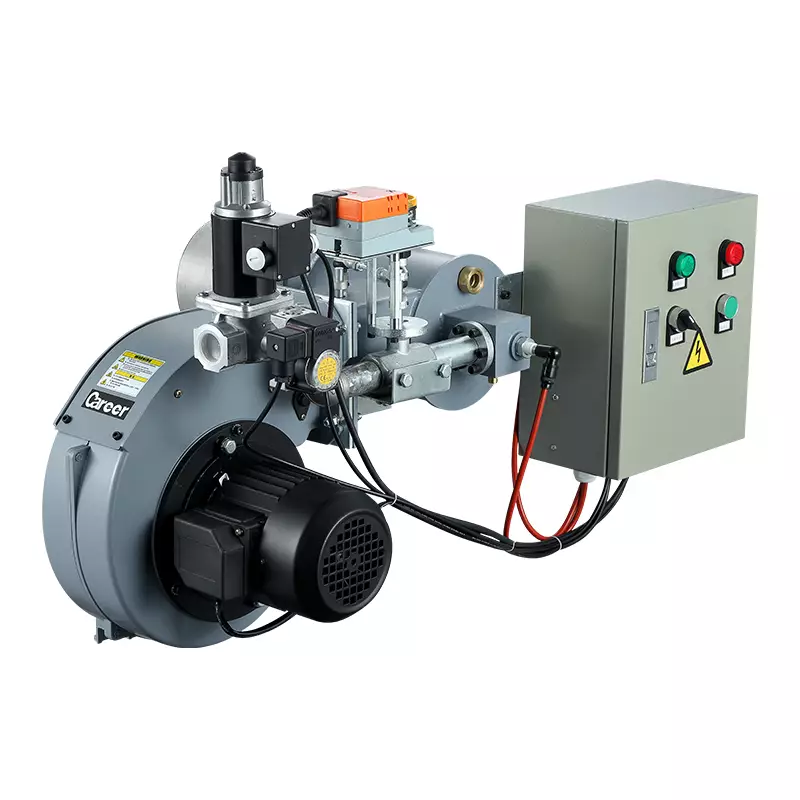
For us at Career Burner, the clearest way to understand the equipment is to follow the combustion sequence rather than start with components. Our reference range uses nozzle-mixing technology for direct-fired industrial applications, keeping fuel and combustion air separate until they meet at the nozzle. That arrangement determines how the flame is formed and controlled.
From fuel supply to stable flame
The operating sequence begins with fuel entering the burner while combustion air is supplied separately. In a nozzle-mixing design, the two streams remain separated through most of the burner and mix at the combustion point. An industrial gas burner then initiates a diffusion flame in the process heating zone.
This differs from a premixed arrangement, where fuel and air are blended before reaching the flame. Nozzle-mix equipment provides a controllable mixing point and supports stable operation across changing firing conditions. The BX series is described as nozzle-mix equipment for demanding direct-fired applications.
Flame control is not simply on or off
Industrial processes rarely require the same heat input throughout an operating cycle. A dryer may need less energy as conditions change, while an oven may require adjustment to maintain its target condition. Burner modulation therefore becomes part of heat control.
At Career Burner, the reference products are designed with high turn-down capability, with the cited BX series reaching up to a 40:1 turn-down ratio. Turn-down describes how far firing capacity can be reduced while maintaining controlled combustion. A higher ratio gives a system more room to match output with variable demand, although performance depends on the complete installation.
What has to stay balanced
Combustion depends on the relationship between fuel and air flow. Too much or too little of either can affect flame stability, combustion quality, and heat delivery. Gas pressure, adjustment, nozzle condition, airflow, and chamber design all influence the result.
That is why choosing a gas industrial burner cannot be reduced to comparing heat capacity. The burner has to match the available fuel, operating pressure, required heat input, and process arrangement. For an existing system, those parameters are useful starting points for determining whether the burner can be integrated without compromising combustion control.
The flame must suit the process
Direct-fired equipment transfers combustion heat directly into the process environment, so flame behavior matters beyond the burner throat. Flame shape, stability, and heat distribution have to suit the chamber receiving the heat. A burner used on an oven, dryer, textile machine, or fume incinerator therefore needs evaluation as part of the application.
The published range lists direct-fired uses including ovens and dryers, paint finishing lines, paper and textile machinery, food baking equipment, coffee roasters, grain dryers, and fume incinerators. Firing patterns and controls can differ by application.
Fuel selection changes the setup
The reference range is compatible with natural gas, LPG, and biogas. Different gases can have different composition, heating value, and supply conditions, affecting fuel flow and the combustion-air relationship.
During replacement or new installation, we check the available gas, supply pressure, required heat input, and control method rather than asking only whether the unit runs on gas. These factors establish whether the burner can operate within the intended process conditions.
Safety depends on controlled combustion
A stable flame is only one part of safe operation. The reference material distinguishes backfire from flashback and notes that incorrect gas pressure, poor fuel-air mixing, or faulty safety controls can contribute to these conditions. Proper tuning, adequate gas flow, and appropriate protective devices are therefore part of responsible installation and operation.
The reference page describes a modular split structure that supports installation and recommends professional installation. Routine service includes cleaning filters, inspecting nozzles, and checking fuel flow. These tasks matter because contamination, wear, or restricted flow can change combustion conditions.
How we evaluate a burner requirement
When we assess a burner requirement, we start with the process, not capacity alone. Fuel type and pressure establish the operating envelope. Required heat input identifies the firing range. Chamber geometry and desired heat distribution then influence how the flame needs to behave.
Control requirements come next. A process with significant load variation may benefit from substantial modulation, while the combustion system must maintain the appropriate fuel-air relationship. Integration, maintenance access, and safety controls also deserve review.
In our work at Career Burner, that workflow makes burner selection an engineering decision rather than a simple component purchase. The unit must produce the required heat while fitting the fuel supply, process conditions, and control architecture.
Understanding the working principle
An industrial gas burner works by bringing fuel and combustion air together in a controlled way, igniting the streams, and delivering heat to the process. Nozzle-mixing designs accomplish this by keeping the streams separate until the combustion point, creating a controllable diffusion flame.
Our published industrial range illustrates this principle across direct-fired equipment, with capacities from 5.3 kW to 348.3 kW and compatibility with natural gas, LPG, and biogas. For anyone evaluating a gas industrial burner, the essential question is not simply “How much heat can it produce?” It is whether its combustion method, firing range, fuel requirements, flame behavior, and controls fit the process that must be heated.