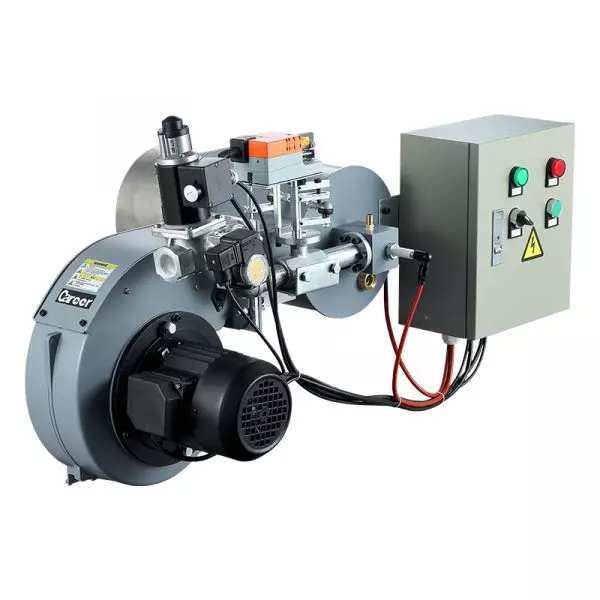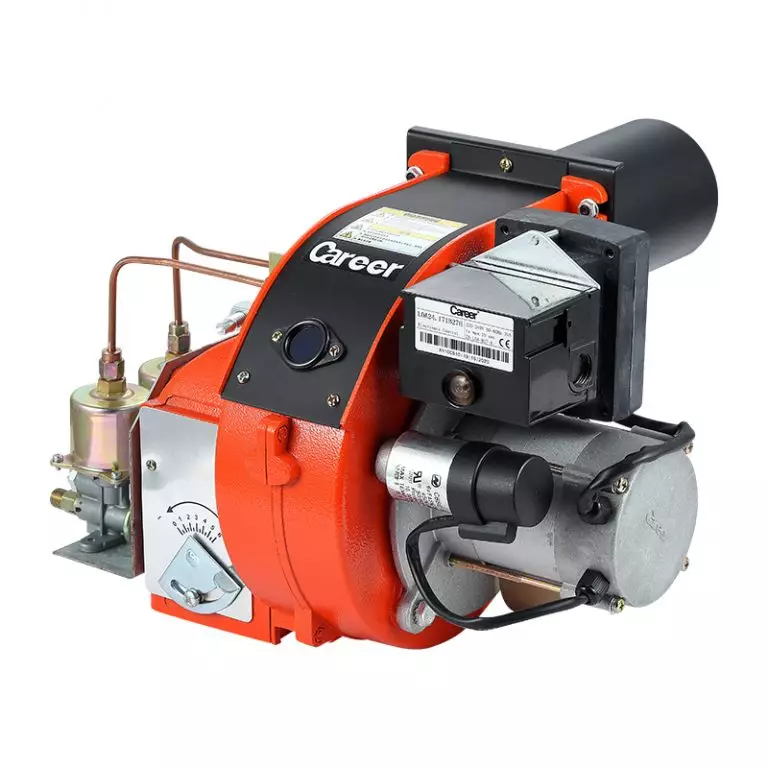
Choosing an industrial burner is not simply a matter of selecting the lowest-priced unit with sufficient power. The right industrial combustion burner must deliver stable process heat while matching the equipment, fuel supply, operating profile, emissions requirements, safety standards, and maintenance resources at your facility.
An industrial burner controls the mixing and combustion of fuel and air to generate usable heat for industrial processes. It is commonly installed in boilers, furnaces, kilns, dryers, ovens, thermal oil systems, hot-air generators, incinerators, and heat-treatment equipment. Because it directly affects fuel consumption, production stability, emissions, and uptime, burner selection should be treated as a long-term operating decision—not only a capital purchase.
At Career Burner, we help customers assess application requirements and configure burner solutions for dependable, efficient industrial heating.
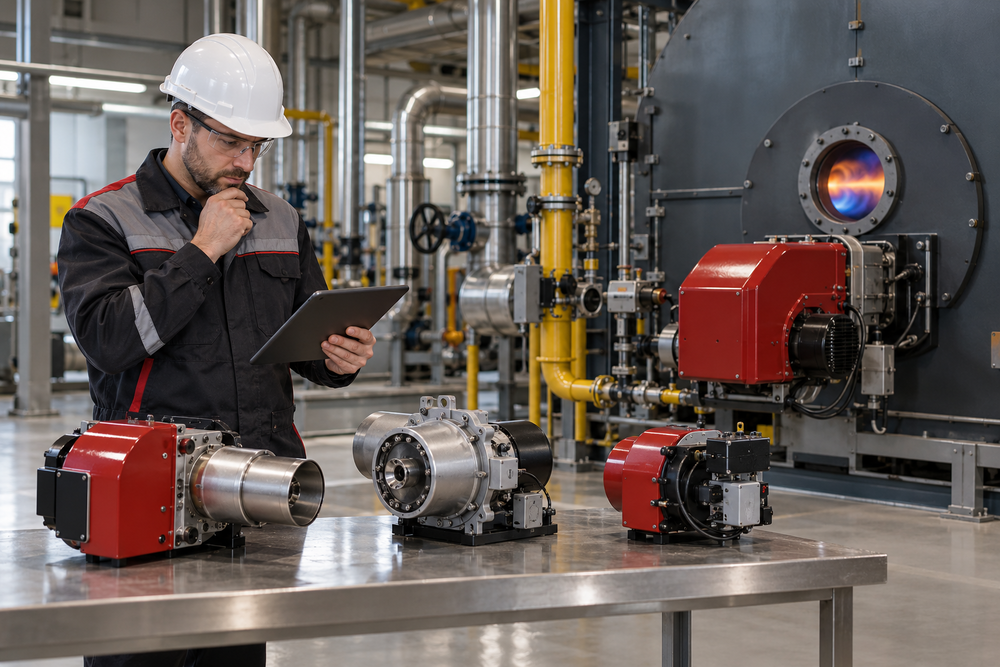
What Should You Consider When Buying an Industrial Burner?
The lowest purchase price does not always create the lowest operating cost. A less suitable burner may consume more fuel, struggle with changing heat loads, require more frequent maintenance, or create compliance issues if emissions performance does not meet local requirements.
When comparing industrial combustion burner systems, focus on these six factors:
- Heat output: The burner must meet the actual maximum and minimum heat demand of the process.
- Fuel compatibility: Natural gas, LPG, biogas, diesel, kerosene, B10 biodiesel blend, and other fuels require different burner configurations.
- Combustion efficiency: Stable air-fuel control and appropriate burner sizing can help reduce fuel waste.
- Emissions performance: NOx and CO performance may be critical for regulated facilities or low-emission upgrade projects.
- Safety: Flame monitoring, fuel shutoff, ignition controls, pressure monitoring, and interlocks are essential.
- Controls and maintenance: The correct control mode and accessible service design help support stable operation and lower lifecycle cost.
The final decision must match both the heating equipment—such as a boiler, dryer, or furnace—and real site conditions, including fuel pressure, combustion-chamber pressure, installation space, electrical supply, production schedule, required temperature range, and emissions limits.
The Complete Industrial Burner Buyer’s Guide
1. Define Your Application and Heat Requirements
Start with the process, not the burner model. Identify whether the burner will heat steam, hot water, thermal oil, combustion air, a furnace chamber, an immersion tube, or the product itself.
Key questions include:
- What type of equipment will the burner serve?
- What operating temperature is required?
- What is the maximum heat load in kW, kcal/h, BTU/h, or another relevant unit?
- Does the process run continuously, intermittently, or in frequent heating cycles?
- Does demand vary significantly during production?
- Is the burner being installed on new equipment or retrofitted to an existing system?
Oversizing can lead to frequent cycling and poor low-load performance. Undersizing may prevent the system from reaching temperature, extending warm-up time and affecting production capacity. A suitable burner should cover peak demand while operating reliably at normal process load.
2. Choose the Right Fuel Type
Fuel availability and fuel quality influence burner selection from the beginning. Gas-fired burners are often selected where natural gas, LPG, or biogas is available. Oil-fired burners remain practical where diesel, kerosene, or B10 biodiesel blend is more accessible or where gas infrastructure is limited.
Before choosing a fuel, review:
- Fuel availability and supply reliability
- Fuel pressure or fuel-delivery conditions
- Fuel quality, filtration, viscosity, and water contamination risk
- Local fuel cost and expected price volatility
- Emissions requirements
- Whether backup or dual-fuel capability is necessary
Career Burner’s gas-fired burner range is designed for applications using natural gas, LPG, and applicable process gases, with capacities from 50 kW to 7,000 kW. Our light-oil range supports diesel, kerosene, and B10 biodiesel blend, with models covering approximately 24 kW to 1,416 kW.
3. Compare Industrial Burner Types
Different burner designs serve different process demands. Common comparisons include:
| Buyer Decision Question | Types to Compare | Simple Explanation | When to Choose Each Option |
| Can combustion gases contact the process air or product? | Direct-fired vs. indirect-fired | Direct-fired burners send heat and combustion gases into the process air stream. Indirect-fired systems transfer heat through a heat exchanger, radiant tube, or immersion tube while keeping combustion gases separate. | Choose direct-fired for fast, efficient heating in applications such as dryers, hot-air generators, and some curing lines. Choose indirect-fired when clean process air or product protection is essential, such as in food processing, liquid heating, or contamination-sensitive production. |
| Does heat demand change often? | Single-stage vs. two-stage vs. modulating | Single-stage burners are on or off. Two-stage (or multi-stage) burners switch between several preset firing rates. Modulating burners continuously vary their output within their turndown ratio. | Choose single- or two-stage control for stable loads and cost-sensitive systems. Choose modulating control for variable loads, close temperature control, reduced cycling, and processes such as boilers, ovens, dryers, and textile dyeing. |
| What flame performance does the process need? | Nozzle-mix vs. premix | Nozzle-mix burners combine fuel and air at the burner outlet. Premix burners combine them before combustion. | Choose nozzle-mix for stable, flexible direct-fired heating and changing operating conditions. Choose premix when the process requires a shorter or more uniform flame, specific heat distribution, or a specialized low-emission design. |
| What are the equipment size and installation conditions? | Monoblock vs. duoblock | Monoblock burners integrate the fan and burner into one compact unit. Duoblock systems use a separate combustion-air fan and ductwork. | Choose monoblock for compact, small- to medium-capacity boilers, ovens, dryers, and retrofit projects. Choose duoblock for large systems, high furnace resistance, complex airflow requirements, or customized industrial combustion burner systems. |
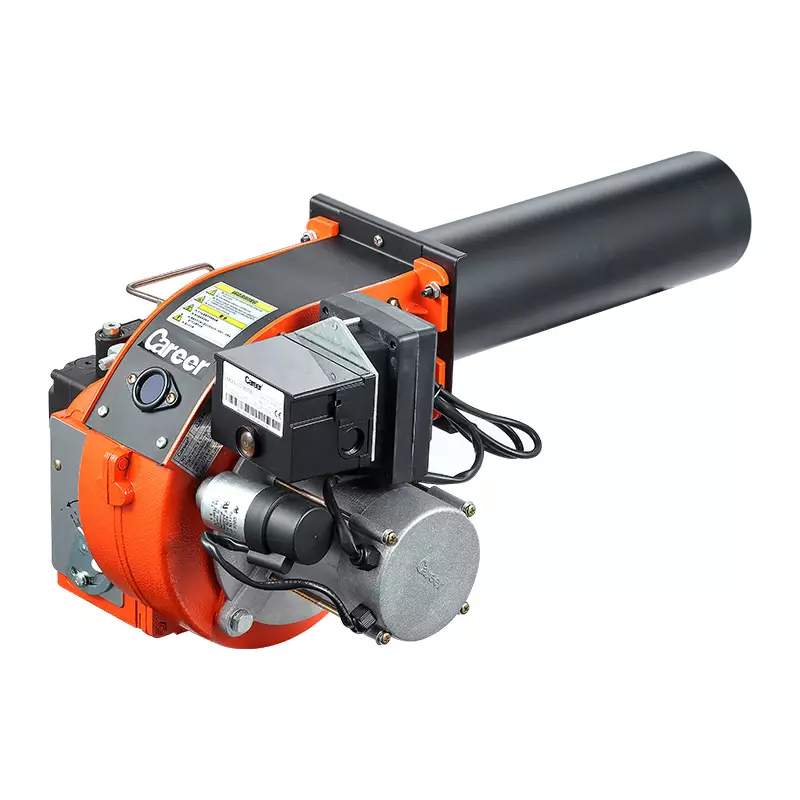
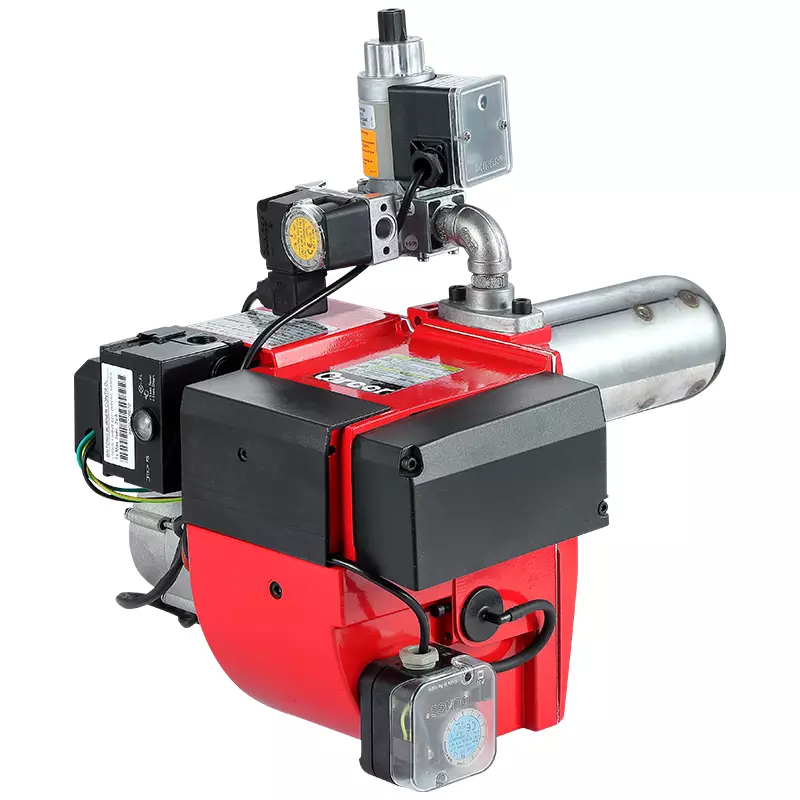
Picture shown: Career Burner CX14 monoblock industrial oil burner
4. Evaluate Capacity and Turndown Ratio
Capacity describes the maximum heat output a burner can provide. However, maximum capacity alone is not enough. You should also evaluate the minimum stable firing rate and the turndown ratio.
Turndown ratio compares maximum burner output with minimum stable output. A 10:1 turndown ratio means that a burner operating at 100% maximum capacity may be able to modulate down to approximately 10% while maintaining stable combustion.
A higher turndown ratio can be valuable when:
- Product loads change frequently
- The process requires close temperature control
- The burner must operate efficiently during low-demand periods
- Frequent on/off cycling needs to be reduced
- The facility operates multiple shifts with changing production levels
For example, Career Burner’s BX20 hot air burner provides a 40:1 turndown ratio, with an output range of 5.3–232.2 kW. This wide modulation range can support textile dyeing and finishing processes that experience changing thermal loads.
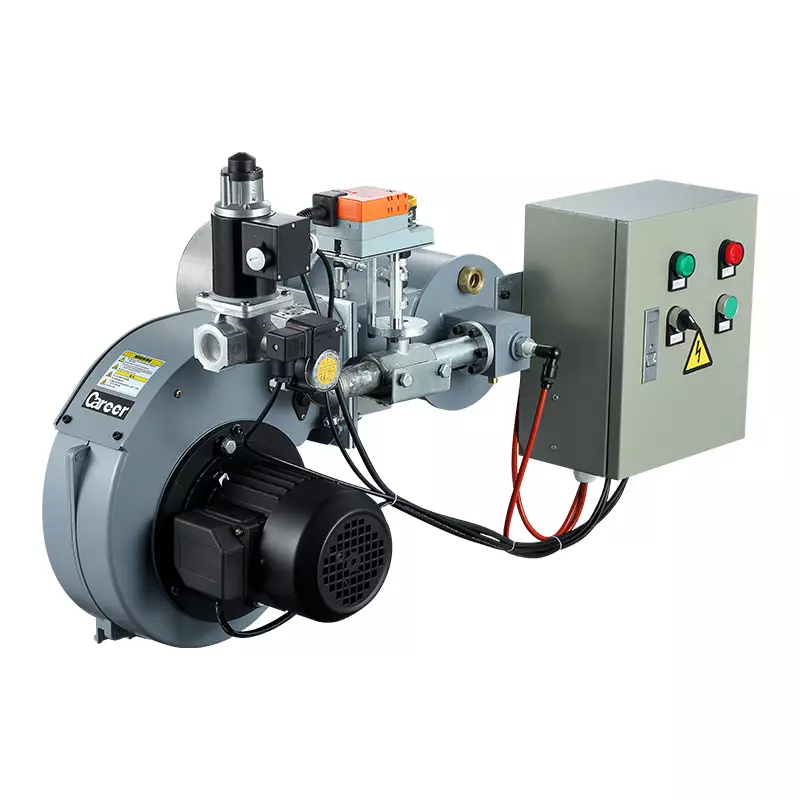
Picture shown: Career Burner BX20 hot air burner for textile stenters
5. Check Efficiency and Emissions Performance
Combustion efficiency depends on correct burner sizing, stable atomization or gas mixing, appropriate excess-air control, proper tuning, and ongoing maintenance. A burner alone does not determine total system efficiency; boiler design, furnace insulation, exhaust temperature, process losses, and operating practices also matter.
When comparing industrial burner manufacturers, ask for performance information under defined operating conditions:
- Fuel type and fuel pressure
- Heat-output range
- Recommended combustion chamber conditions
- Control mode
- NOx and CO results
- Test method and reference oxygen level, where applicable
- Maintenance requirements for sustained performance
For facilities with stringent emissions requirements, low NOx technology may be a priority. Career Burner’s low NOx gas burner range uses approaches such as flue gas recirculation, staged combustion, air-fuel ratio control, and other combustion-management methods to reduce NOx formation. Depending on the burner model, fuel, capacity, combustion-chamber conditions, and control configuration, selected systems can achieve NOx emissions of ≤30 mg/Nm³ under applicable test conditions. These burners can be configured for applications including industrial boilers, incineration systems, and food-processing heating.
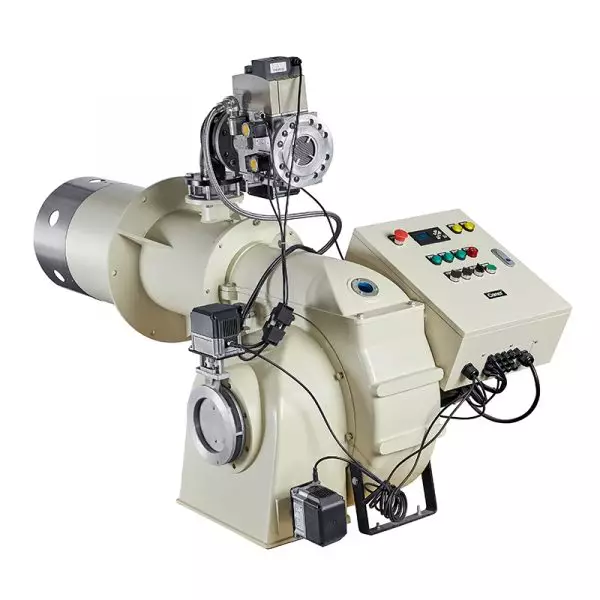
Picture shown: Career Burner NXQEF-3.0 low NOx burner
Always confirm local regulatory requirements and request emissions documentation relevant to your fuel, equipment, load range, and jurisdiction before finalizing an order.
6. Prioritize Safety and Control Systems
Safe burner operation depends on more than a reliable flame. An industrial burner system should also incorporate appropriate ignition, flame supervision, fuel shutoff, pressure monitoring, temperature and pressure interlocks, and emergency shutdown functions.
Important safety and control considerations include:
- Flame sensor type and flame-failure response
- Automatic ignition sequence
- Gas valve train or oil-supply safety configuration
- High/low gas-pressure switches
- Air-pressure monitoring
- Temperature, pressure, and draft interlocks
- Emergency stop functionality
- Boiler management system or PLC integration
- Alarm, fault-history, and remote-monitoring requirements
Never bypass burner safety devices to solve operational issues. If a burner repeatedly locks out, qualified technicians should identify the root cause, which may involve fuel pressure, air settings, ignition components, flame detection, filters, nozzles, controls, or process conditions.
7. Review Installation and Maintenance Requirements
A technically suitable burner can still perform poorly if it is incorrectly installed or difficult to maintain. Review the mounting arrangement, combustion-head dimensions, electrical requirements, fuel piping, ventilation, flue design, access space, and compatibility with the existing furnace or boiler front plate.
Maintenance planning should include:
- Regular inspection of filters, nozzles, electrodes, and flame sensors
- Air-fuel ratio verification and combustion tuning
- Fuel-line and valve inspection
- Fan and motor checks
- Inspection for leaks, vibration, unusual noise, and unstable flame behavior
- Availability of replacement parts and technical support
Before purchase, confirm whether the supplier can provide installation guidance, commissioning support, maintenance documentation, and readily available spare parts.
8. Calculate Total Cost of Ownership
Total cost of ownership should include more than the burner’s purchase price. Consider:
- Initial equipment cost
- Installation and commissioning cost
- Fuel use over expected annual operating hours
- Electricity use for motors, fans, and controls
- Preventive maintenance and spare parts
- Downtime risk and production losses
- Emissions-control or compliance costs
- Expected service life and warranty support
A lower-cost burner may appear attractive initially but cost more over time if its control range is too limited, its fuel consumption is higher, it requires repeated service, or it cannot support future emissions requirements.
Career Burner Recommendations by Application
If you are looking for a suitable burner solution, the following guide provides Career Burner recommendations for different applications. If you need more specific advice, please contact our professional team.
1. Incineration
Key Considerations: Waste incineration requires high-temperature stability, reliable flame monitoring, and robust combustion to support complete combustion of waste materials and minimize unburned emissions.
| Recommended Model | Burner Type | Key Features & Specs | Why It Fits |
| CX5 | Light Oil Burner | Output: 24-66 kW Heat Power: 20k-57k kcal/h | Compact and reliable with efficient mechanical atomization. Ideal for smaller incineration units requiring stable flame control. |
| CX14 | Light Oil / Diesel Burner | Output: 89-172 kW Heat Power: 76.5k-147.9k kcal/h
Control: Fully Automatic | A high-efficiency monoblock burner offering robust heat power (up to 147,900 kcal/h) for medium-to-large waste incineration. |
| GX16 | Industrial Gas Burner | Output: 69-185.7 kW Fuel: Natural Gas / LPG | Provides a highly efficient, clean-burning alternative for incinerators aiming for strict environmental compliance. |
2. Food Processing
Key Considerations: The food industry demands strict emission controls (Low NOx/CO), quiet operation, and highly precise temperature regulation to maintain consistent product quality and food hygiene.
| Recommended Model | Burner Type | Key Features & Specs | Why It Fits |
| GX12A | Industrial Gas Burner | Output: 41-139.3 kW Fuel: Gas / LPG / Biogas | Quiet operation and energy-saving. Delivers clean, stable heat suitable for food ovens, baking, and drying systems. |
| GX16 | Industrial Gas Burner | Output: 69-185.7 kW Fuel: Natural Gas / LPG | A higher-capacity gas option ensuring stable and clean thermal output for larger food processing equipment. |
| BX20 | Hot Air Burner | Modulation: 40:1 Turndown Ratio Output: 5.3-232.2 kW Fuel: Natural Gas & LPG Compatible | Designed for hot air generation. Ideal for food drying systems and hot air furnaces requiring continuous, precise temperature modulation and advanced safety systems. |
| NX Series | Low NOx Gas Burner | Feature: Ultra-low NOx Emissions | Specifically engineered to meet the strictest environmental and hygiene regulations in the modern food industry. |
3. Textile Industry
Key Considerations: Textile processes, especially fabric setting and drying, require consistent hot air distribution, dynamic heat load management, and excellent flame stability to ensure uniform fabric quality without scorching.
| Recommended Model | Burner Type | Key Features & Specs | Why It Fits |
| BX Series (e.g., BX20) | Hot Air Gas Burner | Modulation: Mechanical continuous (40:1 turndown ratio) Air Supply: Forced-draft Safety: Advanced flame detection, pressure monitoring & valve leak monitoring | Specifically designed for textile stenter machines and air heating. Its continuous modulation via servo motor ensures precise temperature control for delicate fabrics, while its robust safety and automated shutoff systems provide reliable, continuous operation. |
4. Industrial Boilers
Key Considerations: Boilers need continuous heavy-duty operation, high energy efficiency, automated safety controls, and fuel flexibility depending on the plant’s existing infrastructure.
| Recommended Model | Burner Type | Key Features & Specs | Why It Fits |
| GX Series | Gas Burners | Efficiency: High Emissions: Low Carbon | Offers reliable, quiet, and eco-friendly gas combustion. Standardized components make maintenance easy for continuous boiler operations. |
| CX Series | Light Oil / Diesel Burners | System: Integrated Air Flow Atomization: High-pressure | Fully automated oil burners that provide the intense, reliable heat necessary for robust industrial hot water or steam boilers. |
5. Metal Melting & Heat Treatment
Key Considerations: Metallurgical applications demand intense, concentrated heat, resistance to high furnace backpressures, and durable construction to survive harsh operating environments.
| Recommended Model | Burner Type | Key Features & Specs | Why It Fits |
| CX Series | Light Oil Burners | Design: Single-stage and two-stage control configurations | Delivers the robust flame and extremely high heat capacity required for smelting furnaces, metal casting, and coating pretreatment. |
Final Thought
An industrial burner is a long-term operating investment, so the purchase decision should consider more than initial cost and rated capacity. Evaluating fuel compatibility, control range, emissions, safety, maintenance, installation, and lifecycle costs can help you choose a suitable solution. If you are planning a new installation or burner replacement, contact Career Burner to discuss your process requirements and explore the appropriate burner configuration.