Few things disrupt industrial production more abruptly than a burner that refuses to stay lit. When the flame sensor fails, the burner control system cannot verify that ignition has occurred, triggering a safety lockout within seconds. Facility managers face unexpected downtime, spoiled product batches, and emergency service calls—all traced to a small but critical component. Understanding why flame sensors fail and how to address those failures keeps production lines running and maintenance budgets under control.
At Career Burner, we have engineered Career Burner combustion solutions for over three decades from our Foshan, China facility, helping industrial clients diagnose sensor issues quickly and restore reliable operation across thousands of installations worldwide.
Contaminated Sensor Rods: The Most Common Culprit
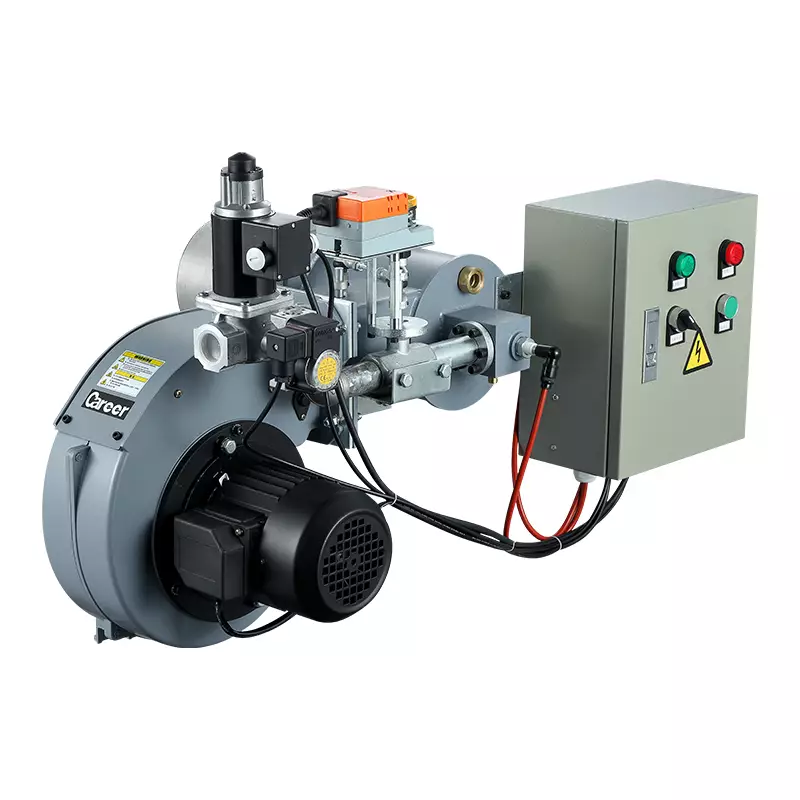
Flame sensors rely on clean surfaces to detect ionization signals from the flame. Over time, carbon deposits, silicone residue from shop air, or fuel additives coat the sensor rod, insulating it from the flame’s electrical signal. For any gas burner for industrial use, this contamination produces intermittent lockouts—the burner starts normally but shuts down after a few seconds when the control fails to “see” flame. Our BX20 Immersion Tube Burner, designed for textile dyeing applications, features modulating control with a 40:1 turndown ratio; even this advanced system suffers sensor contamination in dusty or oily environments. The solution is straightforward: remove the sensor rod during weekly maintenance, clean it with fine emery cloth or steel wool (never sandpaper containing silicone), and reinstall with proper gap distance. For heavy-duty applications, we recommend keeping spare sensors on hand to swap during cleaning.
Mispositioned Or Damaged Sensor Components
A clean sensor still fails if it is positioned incorrectly relative to the burner head or ignition electrode. The sensor tip must reside directly in the flame envelope—too far forward, and it misses ionization; too far back, and the flame lifts away. Additionally, cracked ceramic insulators allow electrical current to ground through the burner chassis, producing a weak or nonexistent signal. At Career Burner, we design our gas burner for industrial use with standardized sensor mounting positions, but vibration from combustion blowers or thermal expansion can shift alignment over months of operation. Inspect the ceramic insulator for hairline cracks during each cleaning. Replace any sensor with visible damage immediately. Our BX20 burner, firing natural gas or LPG into compact immersion tubes for textile finishing, maintains stable flame detection even under dynamic heat loads—provided the sensor remains properly positioned.
Control Module And Wiring Issues
Sometimes the sensor works perfectly, but the signal never reaches the control module. Loose spade connectors, corroded terminals, or damaged wiring between the sensor and controller mimic sensor failure. Use a multimeter to check continuity from sensor connector back to the flame control board. Also verify grounding: a poor chassis ground creates erratic flame signals. For industrial environments with vibration, we recommend dielectric grease on sensor connectors and periodic torque checks on terminal screws. If cleaning, positioning, and wiring all check out, the control module itself may have degraded electronics—particularly in older units subjected to heat cycling.
Reliable Flame Sensing With Career Burner
Flame sensor failures are rarely mysterious once you understand the three diagnostic pillars: cleanliness, position, and electrical continuity. Most lockouts resolve with a simple cleaning and gap adjustment, saving hours of unnecessary component swapping. Career Burner produces Career Burner combustion solutions including our BX20 Immersion Tube Burner, a gas-fired immersion burner for applications requiring precise combustion control with low NOx and CO emissions. Available in capacities from 5.3 kW to 348.3 kW, our industrial gas burners deliver high thermal output and reliable flame stability for textile dyeing, finishing, and other direct-fired heating processes. We recommend keeping spare sensors on your shelf and scheduling monthly inspection of flame detection components. Partner with Career Burner for custom solutions and quick quotes—let our 30-plus years of tested excellence keep your burner firing without interruption.